Summary / TL;DR
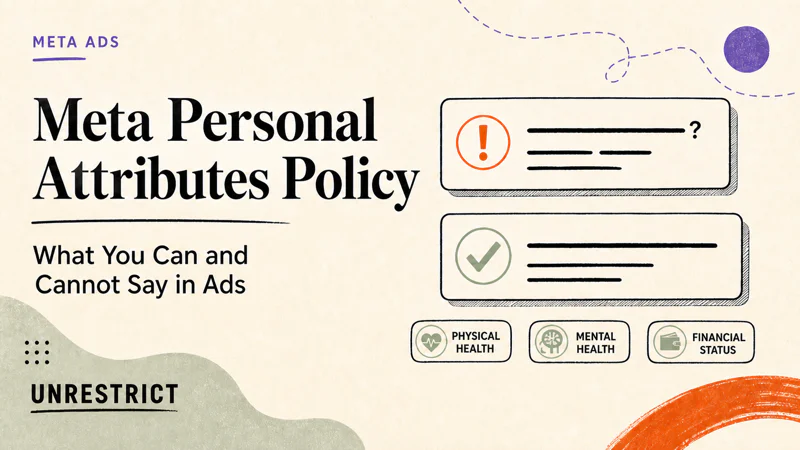
Meta's Personal Attributes policy rejects ad copy that implies knowledge of the viewer's physical health, mental health, or financial status, even when the product or service is eligible to advertise. The test is whether the sentence describes the service or claims a fact about the person reading the ad.
A compliant rewrite describes what the business offers without assigning a condition, diagnosis, or financial hardship to the viewer. "Diabetes treatment and monitoring services are available" passes. "Do you have diabetes?" does not.
Personal-attribute enforcement is an advertising-policy rule evaluated in Ads Manager. It is separate from the data-source classification in Events Manager. Fixing ad copy does not remove a data-source category. Likewise, fixing a data-source category does not get a rejected ad approved.
What is Meta's Personal Attributes policy?
Meta's Personal Attributes policy rejects ads that appear to know something sensitive about the person reading them.
Meta can reject an ad for an eligible clinic, therapy service or financial-assistance firm if the copy implies the viewer has a health condition, a mental-health condition, or a vulnerable financial status. The product can be fine. The ad copy is the problem.
"Book an eye exam near you" describes an available service. "Is your vision getting worse?" implies knowledge of the reader's health. The trigger is the connection between "you" and a protected attribute, not the word "you" itself.
Why this rule exists. After the Andromeda update, Meta's ad system uses creative content as a targeting signal. Meta's AI reads the ad copy, image, and video to determine which people are most likely to engage. When an ad says "Do you have diabetes?", Meta's system uses that language to find people it predicts will respond to it. Meta is effectively selecting people based on a health attribute. Under privacy law, that can constitute a disclosure of protected health information, regardless of how the advertiser configured their targeting. The personal-attributes rule exists because the creative is now part of the targeting.
The full list of protected personal attributes. Meta's policy covers twelve categories: race or ethnicity, religion or beliefs, age, sexual orientation or practices, gender identity, disability, physical or mental health (including medical conditions), vulnerable financial status, voting status, trade union membership, criminal record and name.
This guide covers the four most common in health and financial-services advertising: physical health, mental health, disability and vulnerable financial status.
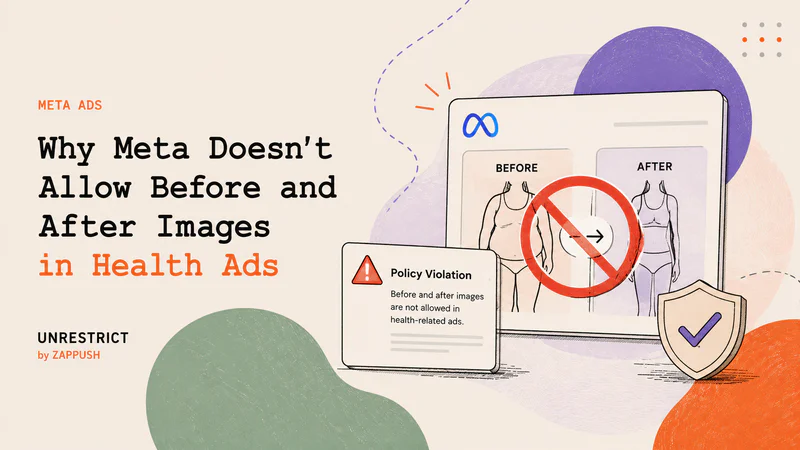
This guide covers ad copy only. Meta's Health & Wellness Advertising Policy also restricts transformation imagery, negative self-perception, weight-loss creative and cosmetic procedures. Those visual and creative rules are covered in our before-and-after images guide. Read below
How personal-attribute enforcement works
Advertising review examines the ad text, text embedded in an image or video, lead form, and destination under Meta's Advertising Standards. Personal-attribute enforcement belongs to this advertising-policy layer.
A question or statement that assigns a diagnosis, mental state or financial hardship to the reader is high risk. Copy that accurately describes the available service, treatment or assistance without claiming the reader has the attribute is the safer pattern.
Events Manager applies a separate classification to a website, app or dataset. Physical health and mental health are advertising-policy attributes; related Events Manager categories may be Health & Wellness – Condition, Provider or Other. Vulnerable financial status may overlap by subject matter with Economic vulnerability or Financial service, but the labels and consequences are not interchangeable.
Treat the two outcomes separately. Rewrite copy when Ads Manager identifies a personal-attributes problem. Inspect the dataset category and event delivery when Events Manager reports restricted or suppressed data. A compliant rewrite cannot remove a data-source classification. For a full explanation of how ad policy categories and data-source categories differ, read: Meta Restricted Categories: Ad Policy vs Data Source Restrictions
The policy has two halves: privacy violations and personal attributes
The full policy name is "Privacy Violations and Personal Attributes." Most health advertisers encounter the personal-attributes half, but the privacy-violations half applies to lead generation.
Privacy violations prohibit ads from sharing or requesting personally identifiable information (PII), personal contact information, residential information, financial information, medical information or information obtained from hacked sources. A lead-form ad that asks "What medications are you currently taking?" or "What is your diagnosis?" is requesting medical information from the viewer. A landing-page form that collects insurance ID numbers or Social Security numbers for pre-qualification is requesting financial and personal information.
The privacy-violations half and the personal-attributes half can both apply to the same ad. A lead form can simultaneously imply a health condition in its introduction ("Struggling with back pain?") and request medical information in its fields ("Describe your symptoms"). Each violation is evaluated independently.
What the policy allows
Meta's Transparency Centre lists specific patterns that are permitted:
"You" and "your" without a personal attribute. "Find a therapist near you," "Book your appointment today," and "Get your free guide" are allowed because they do not connect the pronoun to a protected attribute.
Broad geographic references. Calling someone "American" or "New Yorker" to reference where they live is allowed.
Passing references to gender or age groups. "A service for teens," "Meet seniors," and age ranges are allowed when they describe the audience in general terms without asserting a specific age or condition.
Celebrity or fictional character names. Using public names is allowed; using the viewer's own name is not.
Public service announcements (PSA) about health issues. PSAs that inform the public about a health topic are allowed as long as they do not assert that the viewer or their family has the condition. This matters for health nonprofits and public-health campaigns.
The word "other" is a specific trigger. Meta's examples show that adding "other" implies the viewer shares the attribute. "Meet seniors" is allowed. "Meet other seniors" is not. "Gay dating online now!" is allowed. "Meet other lesbians now!" is not. The word "other" tells the viewer "you are one of this group," which is the inference the policy prohibits.
The policy extends to the viewer's family. Meta prohibits ads from asserting or implying personal attributes of a user or the user's family. "Don't wait! Get your spouse treated for cancer today" is flagged because it implies the advertiser knows a family member's health status. Health advertisers writing caregiver-focused copy ("Help your aging parent," "Support for a loved one with dementia") should describe the available service without asserting that a specific family member has the condition.
The sentence test: describe the service, not the viewer

Read the sentence without the product name. Does it describe what the advertiser offers, or does it tell the reader something sensitive about themselves? "Therapy for anxiety and stress concerns" describes a service. "Your anxiety is getting worse" claims knowledge about the viewer.
The word "you" is not automatically prohibited. "Find a therapist near you" does not assign a mental-health condition. The policy risk appears when the pronoun is connected to a diagnosis, symptom, medical fact, vulnerable financial state or another protected personal attribute.
Questions do not create a safe exception. "Do you have diabetes?", "Struggling with depression?" and "Are you bankrupt?" still connect the reader to sensitive information even though they are phrased as questions.
Physical health: Meta ad-copy examples
Advertising-policy attribute: Physical health and medical information
Meta's illustrated example treats a question that assumes a cancer diagnosis as violating and recommends describing treatment benefits instead.
Related Events Manager categories are not the same rule. Related Events Manager categories may include Health & Wellness – Condition, Provider, or Other, depending on what the source provides. These are not the same labels as the advertising-policy attribute.
These are service-led rewrites, not guarantees of approval. Meta evaluates the complete ad, destination, and any other applicable policy.
Disability: Meta ad-copy examples
Advertising-policy attribute: Disability
Meta lists disability as a separate personal attribute from physical or mental health. Advertisers selling mobility aids, accessibility products, adaptive equipment, or ADA-compliant services encounter this attribute when copy implies the viewer has a disability.
These are service-led rewrites, not guarantees of approval. Meta evaluates the complete ad, destination, and any other applicable policy.
Mental health: Meta ad-copy examples
Advertising-policy attribute: Mental health and medical information
Meta's illustrated example treats copy telling a viewer who is tired of depression to call for therapy as violating and recommends explaining the service and its benefits.
Related Events Manager categories are not the same rule. A mental-health source may be categorized as Health & Wellness – Condition or Provider in Events Manager. The ad-copy decision and dataset decision remain separate.
These are service-led rewrites, not guarantees of approval. Meta evaluates the complete ad, destination, and any other applicable policy.
Vulnerable financial status: Meta ad-copy examples
Advertising-policy attribute: Vulnerable financial status and financial information
Meta's illustrated example treats "Are you bankrupt?" as violating and recommends explaining how the firm helps people going through bankruptcy.
Related Events Manager categories are not the same rule. Related Events Manager categories may include Economic vulnerability or Financial service. Economic hardship and the provision of financial services are different classifications, and neither is identical to the ad-policy wording.
These are service-led rewrites, not guarantees of approval. Meta evaluates the complete ad, destination, and any other applicable policy.
Personal attributes and data-source categories are related, not interchangeable

Meta uses different language in different systems. Physical health, mental health, and vulnerable financial status appear in the Personal Attributes advertising rule. Events Manager categorizes the website, app, or dataset and can apply data-sharing restrictions under different category names.
A successful ad rewrite can resolve an advertising-policy problem. It cannot by itself change a dataset category or restore an event that Meta restricts. Conversely, a compliant data payload does not repair ad copy that assigns a sensitive attribute to the viewer.
Why you may be seeing it
Review the source against these common signals. One signal does not prove the category or policy outcome, so confirm the result in the live Meta interface.
Questions that assume a diagnosis or symptom, such as "Suffering from anxiety?" or "Tired of your chronic pain?"
Copy that states or implies body weight, disability, sexual orientation, gender identity, or another protected attribute.
Image or video text that states a diagnosis, mental state, debt status or other sensitive fact about the person viewing it.
Landing-page headlines and lead forms that repeat the same personal inference even when the ad itself is neutral.
Lead-form questions that collect condition details and are then included in URLs, event names or event parameters.
Lead forms or landing pages that request medical information (current medications, diagnosis, symptoms) or financial information (Social Security numbers, account numbers) from the viewer. This triggers the privacy-violations half of the policy, not the personal-attributes half.
How to check your account

Read the rejection reason in Ads Manager. Open the rejected ad, select See details, and record the named policy. Do not diagnose a personal-attributes issue from campaign performance alone.
Underline every viewer claim. Mark sentences containing you, your, or a question about the reader. Keep neutral invitations. Rewrite sentences that attach the reader to a condition or protected attribute.
Apply the service-versus-viewer test. Ask whether each sentence describes what the business offers or claims a sensitive fact about the person. Preserve factual service language and rewrite the viewer claim.
Review every advertising surface. Check the primary text, headline, description, words inside the creative, lead-form introduction, landing-page headline and form labels. A neutral ad cannot reliably compensate for a destination that makes the same personal inference.
Check Events Manager separately. Open Events Manager, choose the dataset and review Overview, Diagnostics and Settings. A data-sharing notice requires a category and payload review, not another copy rewrite.
What does not fix it?
Deleting every use of "you." Meta's examples allow "you" and "your" when the sentence does not mention a prohibited personal attribute. Removing the pronoun can make the copy awkward without fixing the actual inference.
Turning the statement into a question. A question can still imply that the advertiser knows or suspects the viewer has the attribute. "Depression getting you down?" remains viewer-focused even though it ends with a question mark.
Changing only the creative. A neutral image does not repair a headline, destination, or form that still implies the viewer has a condition.
Assuming approval clears the dataset. Ad approval says the ad passed review at that time. It does not confirm that Meta accepts every event or parameter sent from the categorized data source.
What fixes it
Write from the service outward. State what the clinic, product, program or firm provides, who it is designed to help in general terms, and what the next step involves. Avoid wording that diagnoses, labels, or reveals the viewer.
Use the same rule across every surface. The ad, creative text, lead form, and landing page should describe the offer consistently. A lower-risk rewrite is not a guarantee of approval because Meta evaluates the entire ad and other applicable policies.
If Events Manager still shows a restriction after the ad language is compliant, inspect event names, URLs, and parameters for sensitive context. Send only the permitted information needed for measurement, and validate the resulting event in Test Events and Diagnostics.
Confirm the restriction before changing your stack
Run the free Meta Health & Wellness restriction audit. If Events Manager confirms restricted or suppressed event sharing, Zappush can review the signal path and the fields sent from the browser and server.