TL;DR / Executive Summary
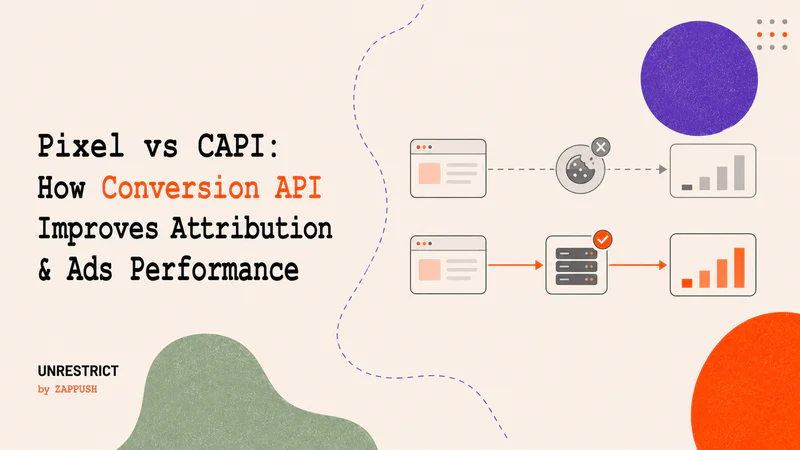
Why Pixel fails: Browser tracking loses data due to GDPR/CCPA, iOS14 App Tracking Transparency, Safari/Firefox ITP, and ad blockers.
Why CAPI works: The Conversion API (CAPI) sends events directly from your server, providing a stable data path that browsers or devices cannot block.
How to run it: Use Pixel + CAPI together and enable deduplication with Event IDs to avoid double-counting.
What you gain: Higher attribution accuracy, better match quality, lower CPA, profit-level optimisation, and the ability to send offline CRM conversions.
What is Conversion API?
The Conversions API (CAPI) is a server-to-server data solution that allows your business to send accurate, first-party conversion data (both web events and offline sales) directly to advertising platforms like Meta, Google, TikTok, Snapchat, among others.
It works by establishing a direct connection between your server and the ad platform, which is immune to the data loss caused by browser restrictions, ad blockers, and mobile operating system privacy settings. CAPI's primary function is to deliver a complete, high-fidelity signal, the fuel for the platform's optimisation algorithms, ensuring your ad spend targets users who truly matter to your internet business.
Why did tracking shift from Pixel to Conversion API?
For years, browser-based tracking was simple and reliable. A user visited your website, a cookie landed in their browser, and the Pixel reported every action back to Facebook or Google. Attribution was clean. Conversions were easy to measure. This system powered the entire ad ecosystem for more than a decade.
When the Cambridge Analytica scandal broke in 2018, it fundamentally fractured public trust in how data was handled.
Regulations tightened: GDPR and CCPA limited how much user data could be collected and how identifiers could be shared.
Ad blockers rose: A large percentage of users now block pixel scripts entirely.
Apple reframed privacy: Safari and Firefox introduced Intelligent Tracking Prevention (ITP), reducing cookie lifetimes and blocking cross-site tracking.
Around the same time, Apple doubled down on repositioning its products centred around privacy. You’ve likely seen Apple’s ‘Privacy. That’s iPhone' campaign. But it was the iOS 14.5 update that gave Apple's users a choice to opt in or out of tracking at scale, removing the identifiers the Pixel relies on, with a single user choice.
Why does this break Pixel-only setups?
A Pixel depends on the browser to detect and send events.
When ATT or tracking prevention is active:
The Pixel still fires
But the identifiers needed to send a “Purchase” event are missing or blocked
So Meta/Google cannot match the event to the person who clicked the ad
This creates the common problem marketers see today:
Purchases happen
But they do not appear in Ads Manager
Optimization worsens
Costs rise
The data connection between user actions on your website and conversion signals received by the ad platform is now broken.
Why CAPI solves this problem
Conversion API sends events directly from your server to Meta or Google. This removes the fragile browser layer and creates a stable, permissioned data path.
CAPI improves data reliability because:
Your server cannot be blocked by ATT or ITP
API events don’t rely on cookies or browser permissions
You control what data is collected, hashed, and transmitted
Match quality improves because server-side identifiers (email/phone) are stronger than browser cookies
Is CAPI bypassing privacy?
No. CAPI is a privacy-aligned measurement method. You decide what data is collected, how it is hashed, and when consent applies. It shifts measurement from “browser-based tracking” to first-party data you intentionally send.
Platforms Supporting Conversions API
Meta Conversions API
Google Ads API
LinkedIn Conversions API
Twitter/X Conversions API
Snapchat Conversions API
Pinterest Conversions API
Reddit Conversions API
The CAPI Advantage: Data Control and Signal Resilience
The fundamental shift to the Conversion API hands control back to the advertiser. By routing events through your own server, you transform low-quality, browser-dependent signals into rich, reliable, first-party data. This server-side infrastructure is the key to maintaining accurate measurement and high-performance advertising in a privacy-first ecosystem. By enriching event data with first-party data parameters, you help the platform improve user matching.
Boosting Event Match Quality (EMQ)
Event Match Quality (EMQ) is the score Meta assigns to your data, measuring how accurately it can link a conversion event back to a specific user who saw your ad. The Pixel relies on weak, short-lived browser data. CAPI enables you to securely transmit Customer Data Parameters (CDPs), such as hashed email addresses, phone numbers, and full names, directly from your server. Sending these strong identifiers drastically raises your EMQ score (ideally 8.0/10 or above), leading directly to a lower cost per acquisition (CPA).
Data Transformation and Enrichment
The browser-side Pixel sends data exactly as it appears on the website. Your server, however, can perform powerful data transformations. Before sending an event to Meta, you can integrate with your CRM to attach a customer's lifetime value (LTV) or estimated profit margin to the Purchase event. This ability to send enriched, business-specific data allows you to optimise your ad campaigns for profitable purchases, a capability impossible with client-side tracking.
Unlocking Offline Conversion Syncs
One of CAPI's most powerful applications is connecting online ad spend to physical or delayed revenue. If a user clicks an ad but completes the purchase days later over the phone or in your CRM, the Pixel misses it. CAPI allows you to sync these offline conversions directly from your CRM back to Meta, ensuring Meta optimises based on true sales data (e.g., Sales Qualified Leads or confirmed purchases).
How to leverage first-party data with Conversion API
Customer journey and purchase behaviour vary. Some may choose to convert offline, checkout a low-average order value cart, and others may choose to pay in cash on delivery (COD - an India-specific payment option). Your Ad platform's AI is as good as the data you feed it. But Ad platforms' conversion optimisation actions are standard and limited in nature. With Conversion API, you can optimise your campaigns for synthetic or custom events.
The customer journey is complex, involving actions that may occur outside of the immediate browser session, such as offline conversions, repeat purchases, or transactions involving specific payment methods. While advertising platforms offer standard conversion actions, they often lack the necessary business-specific context. The Conversion API (CAPI) addresses this by enabling the transmission of enriched first-party data, allowing advertisers to define and optimise for Custom (or Synthetic) Events that directly correlate with profitable business outcomes.
Optimising for Net New Customers (nCAC) Growth
When campaigns optimise solely for the generic 'Purchase' event, algorithms frequently favour quick, low-cost conversions from existing, highly engaged audiences. This phenomenon can inflate Return on Ad Spend (ROAS) while obscuring a deficit in new customer acquisition. To mitigate this, advertisers can implement a custom event, such as a New Customer Purchase event, and optimise for New Customer Acquisition Cost or nCAC. This strategic signal isolates and prioritises the acquisition of genuinely new users, thereby training the algorithm to allocate spend toward sustainable, long-term customer base expansion.
Driving Higher Average Order Value (AOV) via Custom Events
Advertising algorithms are engineered to minimise the cost per conversion, which often results in a disproportionate budget allocation toward low-Average Order Value (AOV) impulse purchases. This trend can hinder the visibility of higher-value products. The CAPI allows a business to define success not just as a purchase, but as a custom event, such as a High Value Purchase event, based on a specific AOV threshold. This mechanism shifts the optimisation signal, reallocating budget and learning to identify and target users exhibiting a higher propensity for large, profitable transactions.
Mitigating Risk with Payment Method Segmentation (COD vs. Prepaid)
In specific markets, payment methods like Cash on Delivery (COD) introduce significant business risk through high Return-to-Origin (RTO) rates. When the algorithm optimises for a generic 'Purchase' event, it includes these unstable COD orders, leading to wasted ad spend and corrupted learning signals. By sending a segmented custom event, such as a Prepaid Purchase, advertisers can instruct the platform to optimise only for secured transactions. This strategy ensures the ad spend is leveraged against confirmed revenue, drastically improving the accuracy of reported ROAS.
Ultimately, CAPI-enabled custom events serve as the strategic bridge between your raw marketing data and true business value. When faced with challenges like stagnant new customer growth, inefficient ad spend due to high-risk transactions (like COD), or even navigating complex compliance landscapes, such as Meta's stringent health and wellness advertising policies, the ability to define and send clean, reliable, and segmented first-party data is the most powerful tool available. This control allows advertisers to solve specific business problems and ensures the advertising platform is optimising for sustainable, profitable success, not just cheap, high-volume vanity metrics.
What is the difference between Pixel and Conversion API?
You only need to understand one thing: Pixel sends data from the browser; CAPI sends data from your server.
The location of the data transfer determines how the systems behave.
How Pixel (client-side tracking) works
Pixel tracking depends on the user’s browser to capture and send events.
Trigger: A user visits your website
Execution: The browser loads the Pixel script
Limitation: Cookies, ITP, ATT, and ad blockers can block or strip identifiers
Failure mode: If the script is blocked, the conversion never reaches the ad platform
Pixel is effective when the browser cooperates, but unreliable when privacy controls interfere.
How Conversion API (server-side tracking) works
CAPI sends events directly from your server to Meta or Google.
Trigger: A user performs an action (e.g., purchase, form submission)
Execution: Your server records the event
Transmission: The server sends a signed, permissioned API request
Advantage: Browser restrictions cannot block server-to-server communication
Because CAPI runs on your backend infrastructure, it bypasses the fragility of browser tracking entirely.
Summary: Pixel vs CAPI
Why run both Meta Pixel and Conversion API together?
You might ask, "If CAPI is better, why keep the Pixel?"
That's because Meta recommends running both tracking tools concurrently to ensure event data is captured reliably.
Meta advises
“We recommend that you use the Conversions API in addition to the Meta Pixel, and that you share the same events using both tools.” Facebook Developers
Recommended setup
Install the Meta Pixel on your website to capture browser‐based events.
Implement the Conversions API from your server to send the same events directly to Meta via server-side setup.
Deduplicate the events, ensuring each event includes the same event_id so Meta knows they are the same action.
This dual path increases reliability, match quality, and ensures Meta’s algorithm receives a more complete dataset.
Why this setup matters
Browser tracking (Pixel) can fail because of ad-blockers, tracking prevention, dropped cookies, or denied permissions (e.g., ATT).
Server‐side tracking (CAPI) is less affected by those issues.
By running both, you give Meta two independent data paths: when one fails or is blocked, the other still delivers the event.
Meta will automatically deduplicate matching events using event_id and timestamps, avoiding double-counting.
This robust setup helps Meta optimise delivery, audience building, and conversion measurement.
How to implement correctly
Generate a unique event_id for each conversion or user action.
Attach that same event_id to both the Pixel event (browser side) and the CAPI event (server side).
Include user identifiers (hashed) and timestamps in both events to boost match quality.
Use Meta’s Events Manager to verify that events are received and deduplicated.