
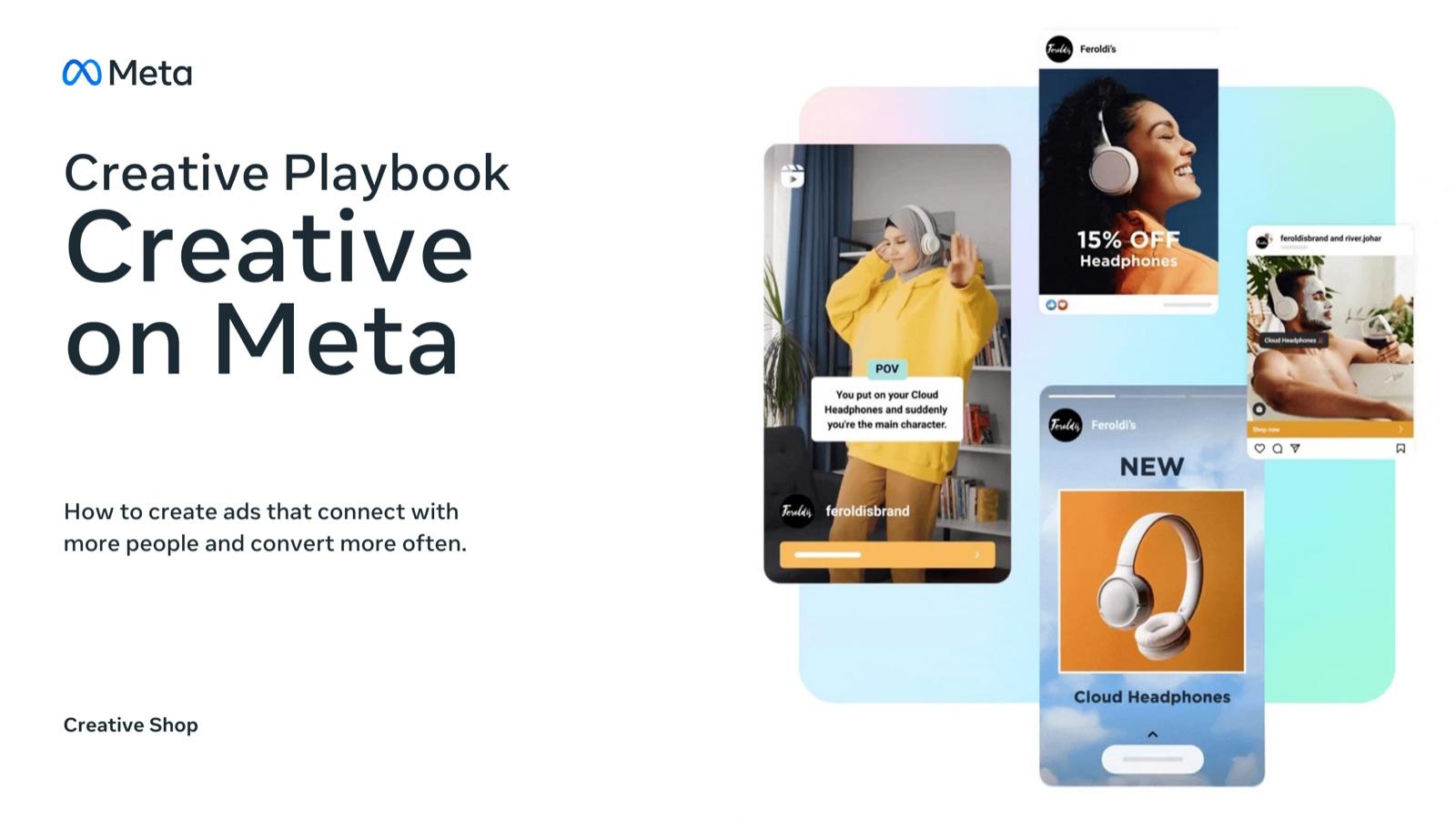
Meta's 2026 Creative Playbook, from its Creative Shop team, makes one argument: give Meta's delivery system more ads that are genuinely different from each other, and it will match a better ad to each person. Meta calls this creative diversification. The playbook then shows how to produce that variety without a bigger budget: build concepts from customer motivators, shoot vertical video with audio first, reuse every shoot across formats, film several hooks per video, and change one part of a winning ad at a time. Below is every section in order, what Meta recommends, the numbers Meta reports, and what to do with it before Black Friday.
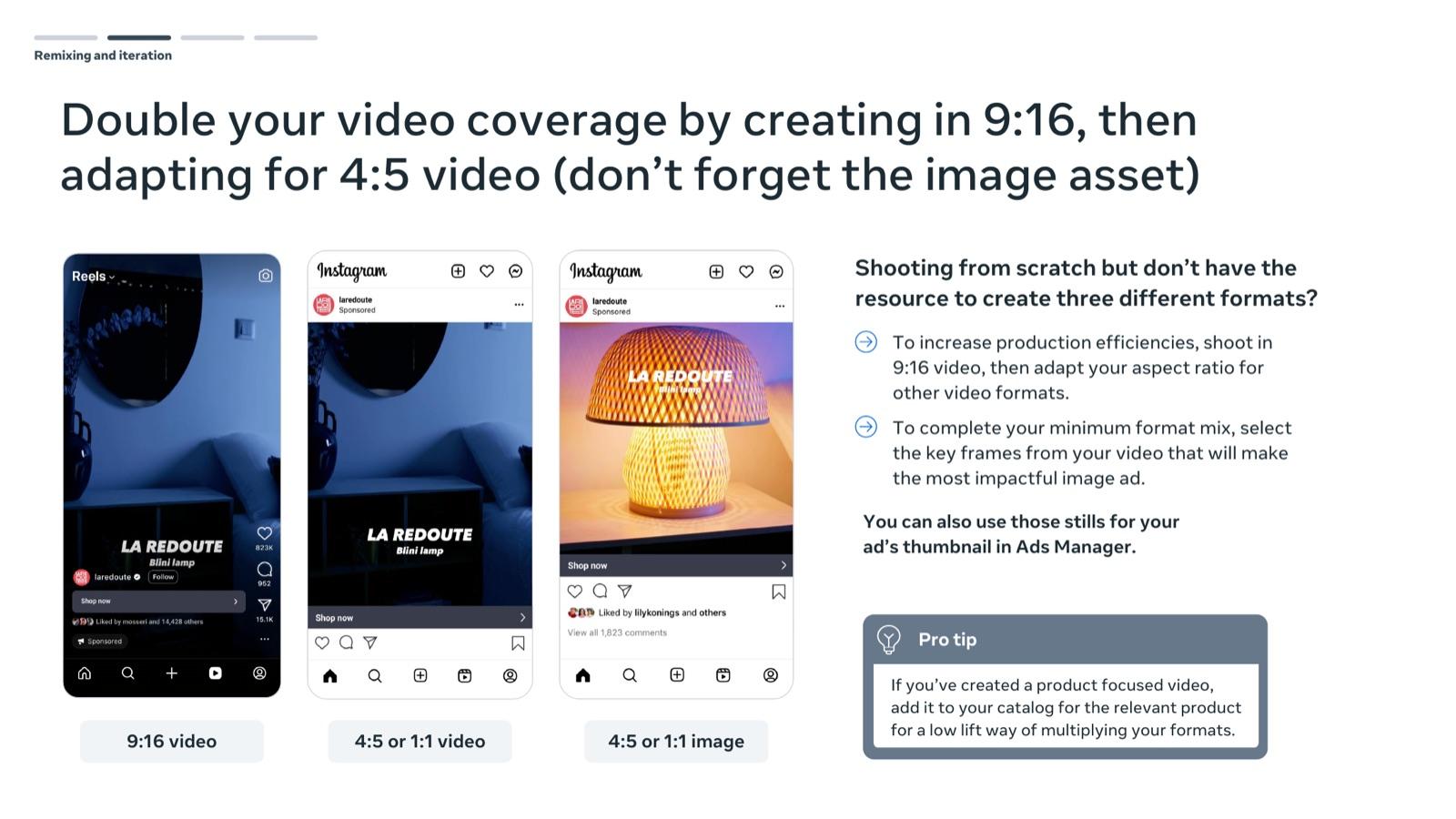
- Put at least three formats in every ad set: a 9:16 video with audio, a 4:5 or 1:1 video, and a 4:5 or 1:1 image. Meta reports 9.1% lower cost per result for ad sets that have all three.
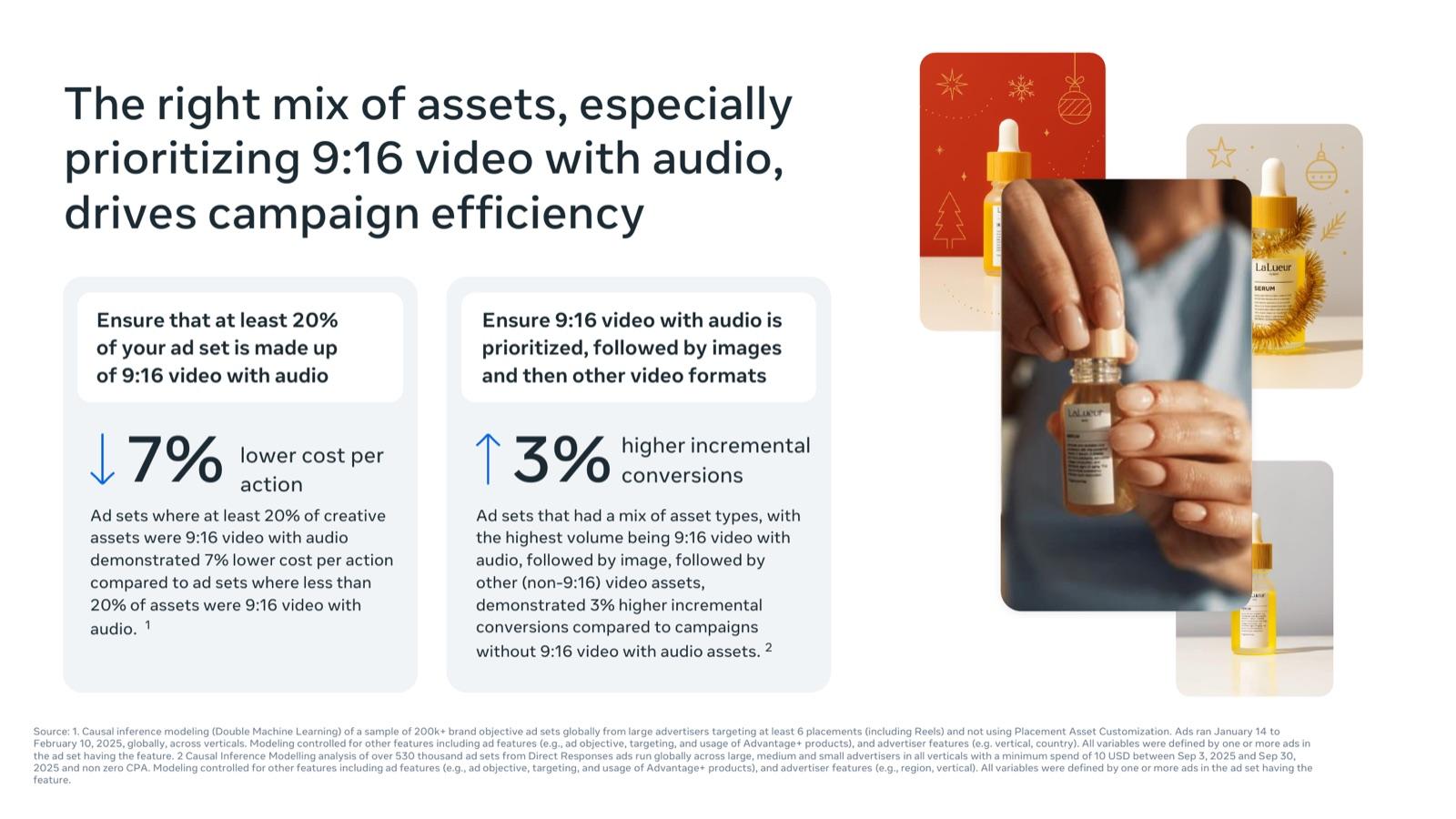
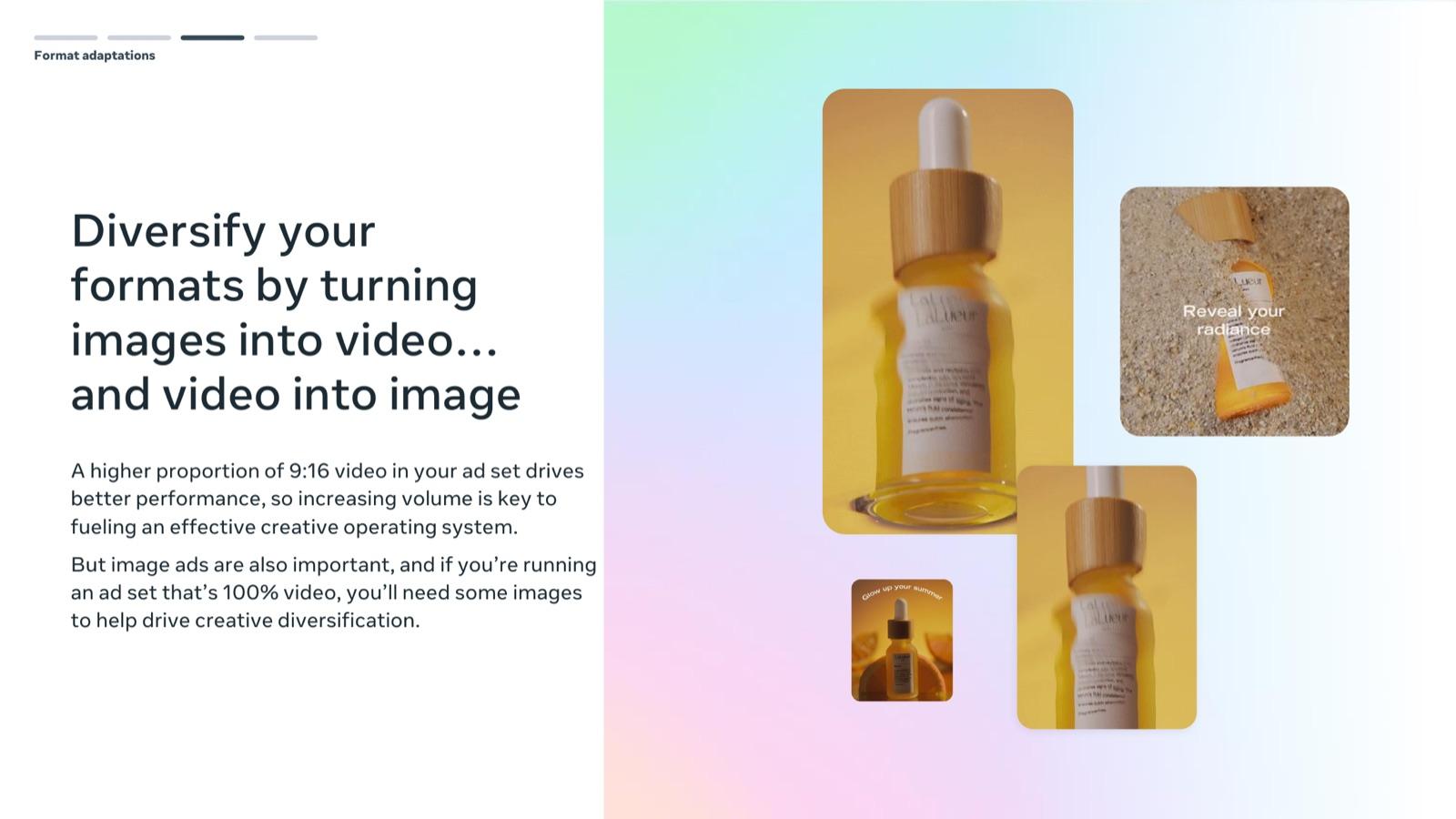
- Make 9:16 video with audio at least 20% of the ad set. Meta reports 7% lower cost per result above that share.
- Build concepts from motivators (why people buy) and barriers (why they hesitate), not from demographics.
- To get more from a winning ad, change one part at a time: the hook, the visual style, the benefit, or who is speaking.
On this page
What the playbook is and who it is for
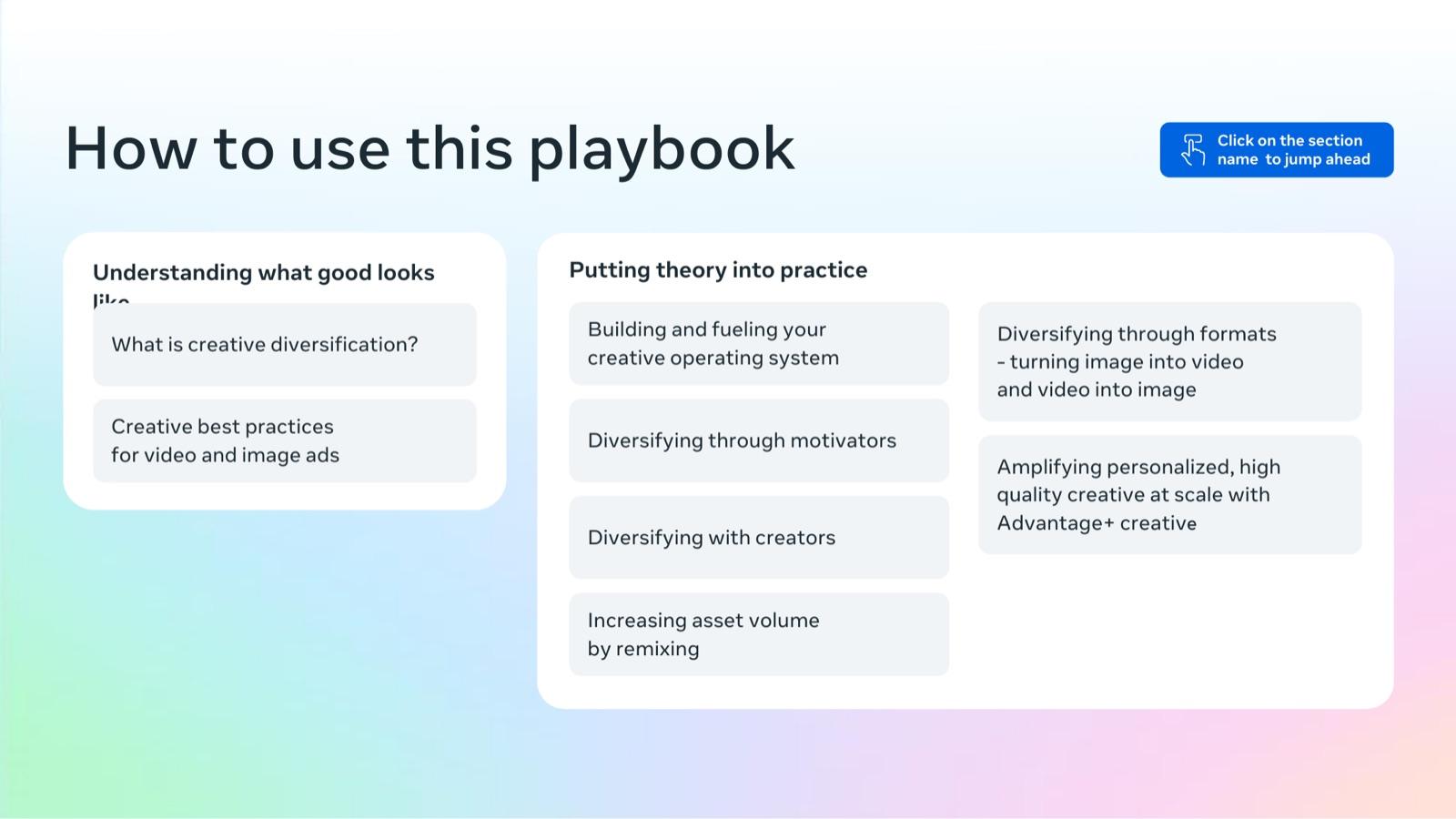
The playbook is published by Creative Shop, Meta's in-house creative team. It is written for advertisers running direct-response campaigns on Facebook and Instagram, and it is organised in two halves. The first half defines what good creative looks like on Meta in 2026. The second half turns that into a working system: concepting, remixing, adapting formats, and using Meta's generative AI features.
Every statistic in the playbook comes from Meta's own analysis or research Meta commissioned. We quote those numbers as Meta reports them, with the study period, because a result from one test window will not hold for every account.
| Part | Section | The question it answers |
|---|---|---|
| 1. What good looks like | Creative diversification | Why does variety inside an ad set matter? |
| 1. What good looks like | Best practices for video and image | What does a strong single ad look like? |
| 2. Putting it into practice | Concepting | Where do new ideas come from? |
| 2. Putting it into practice | Remixing and iteration | How do I get more ads from what I have? |
| 2. Putting it into practice | Format adaptation | How do I turn one asset into three formats? |
| 2. Putting it into practice | Automated personalization | Which Advantage+ creative features help? |
Section 1: creative diversification
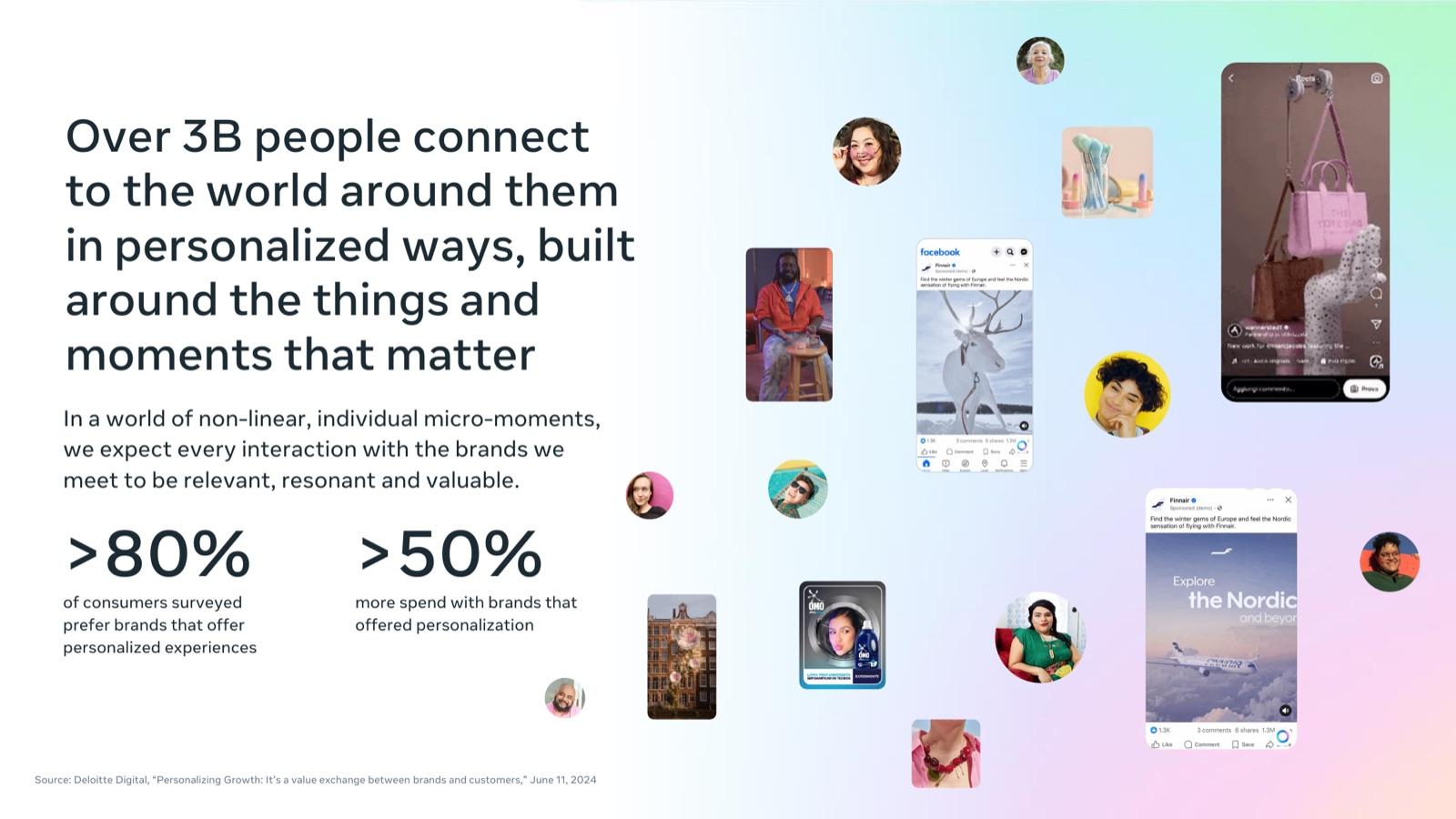
Meta's delivery system decides which ad each person sees. It can only choose among the ads you give it. If every ad in an ad set is a 4:5 product photo with a discount headline, there is nothing to choose between. If the set contains a vertical video of a customer, a product demo and a plain image with a review quote, the system can show each one to the people most likely to respond to it.
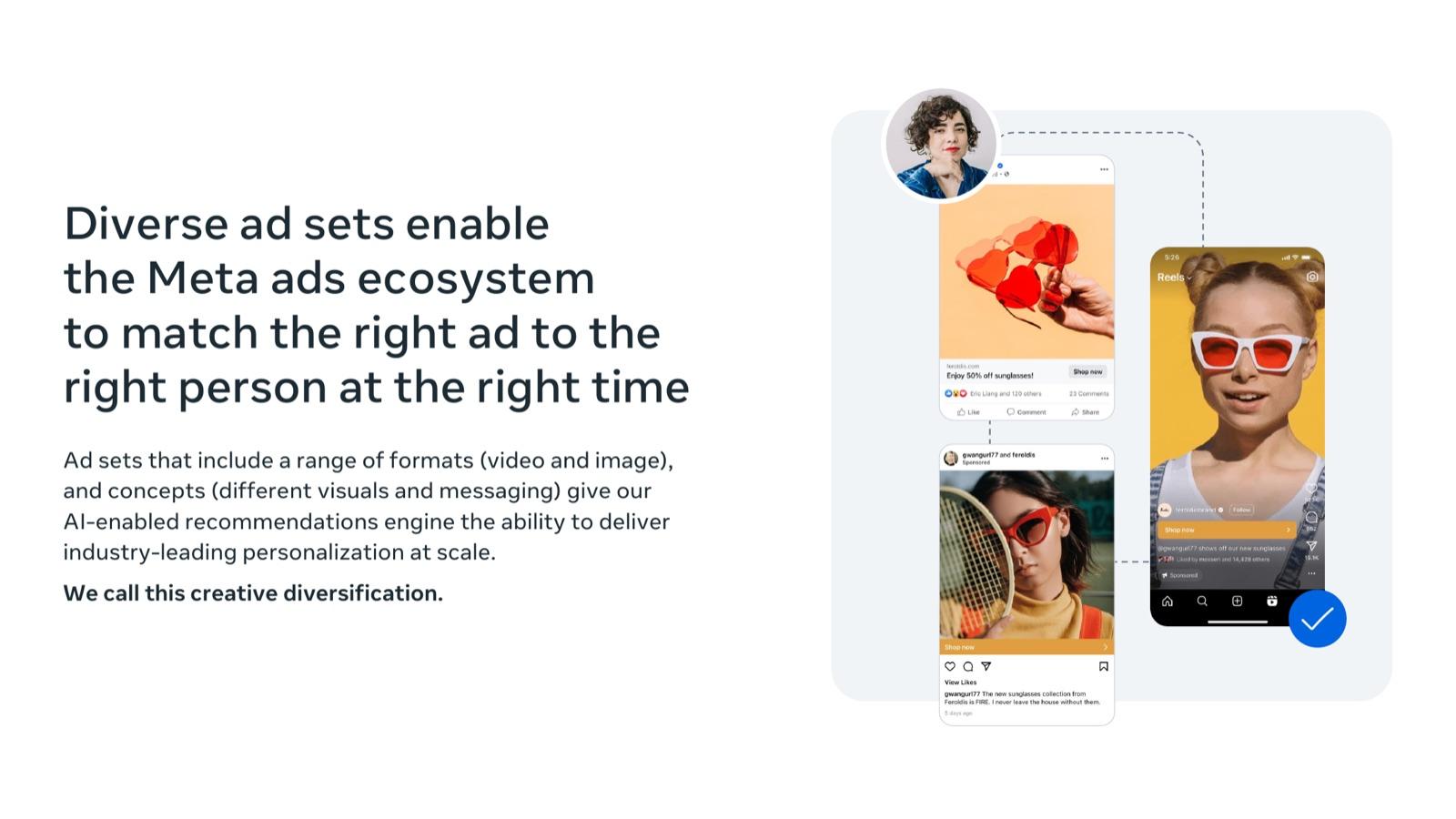
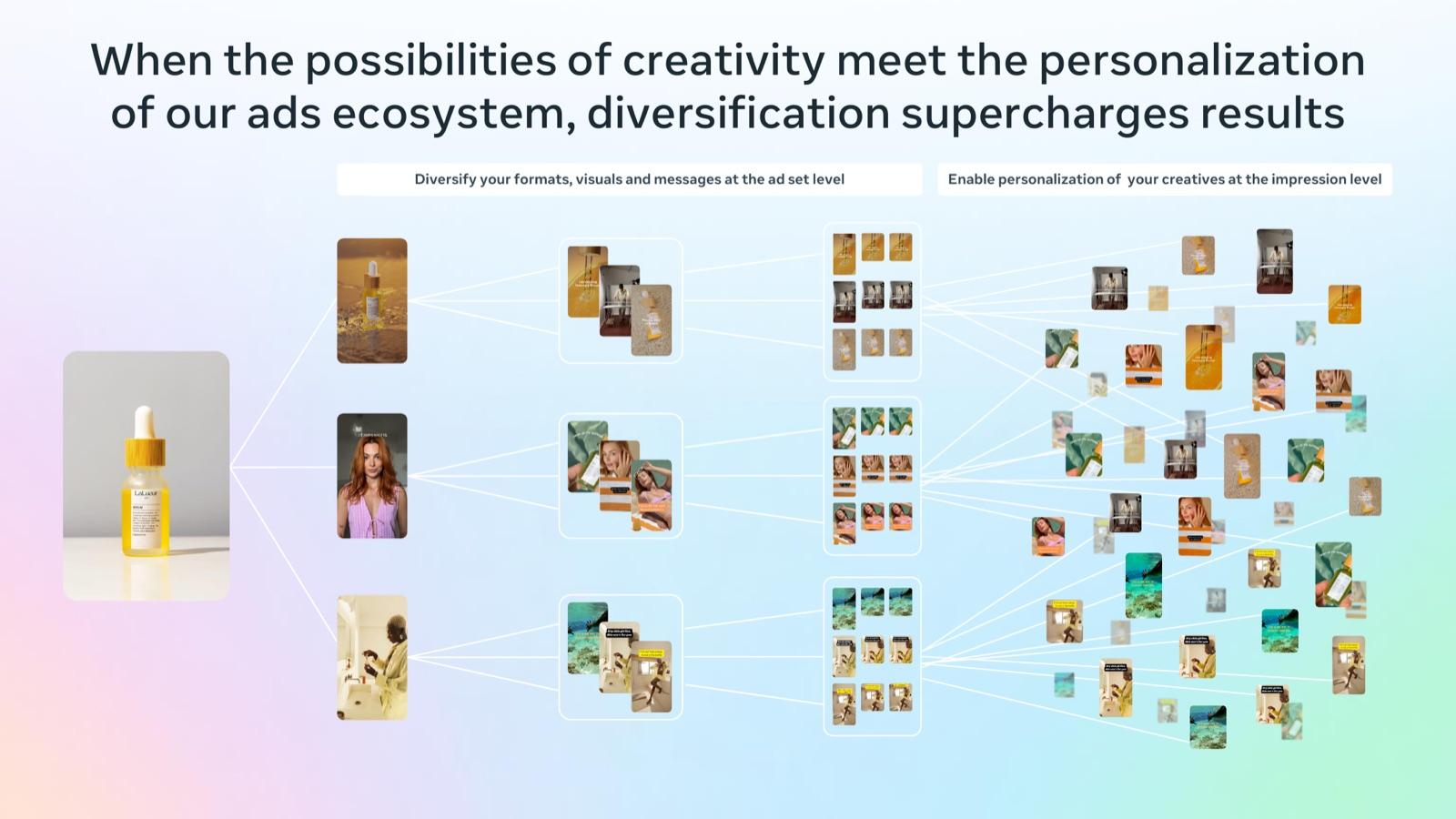
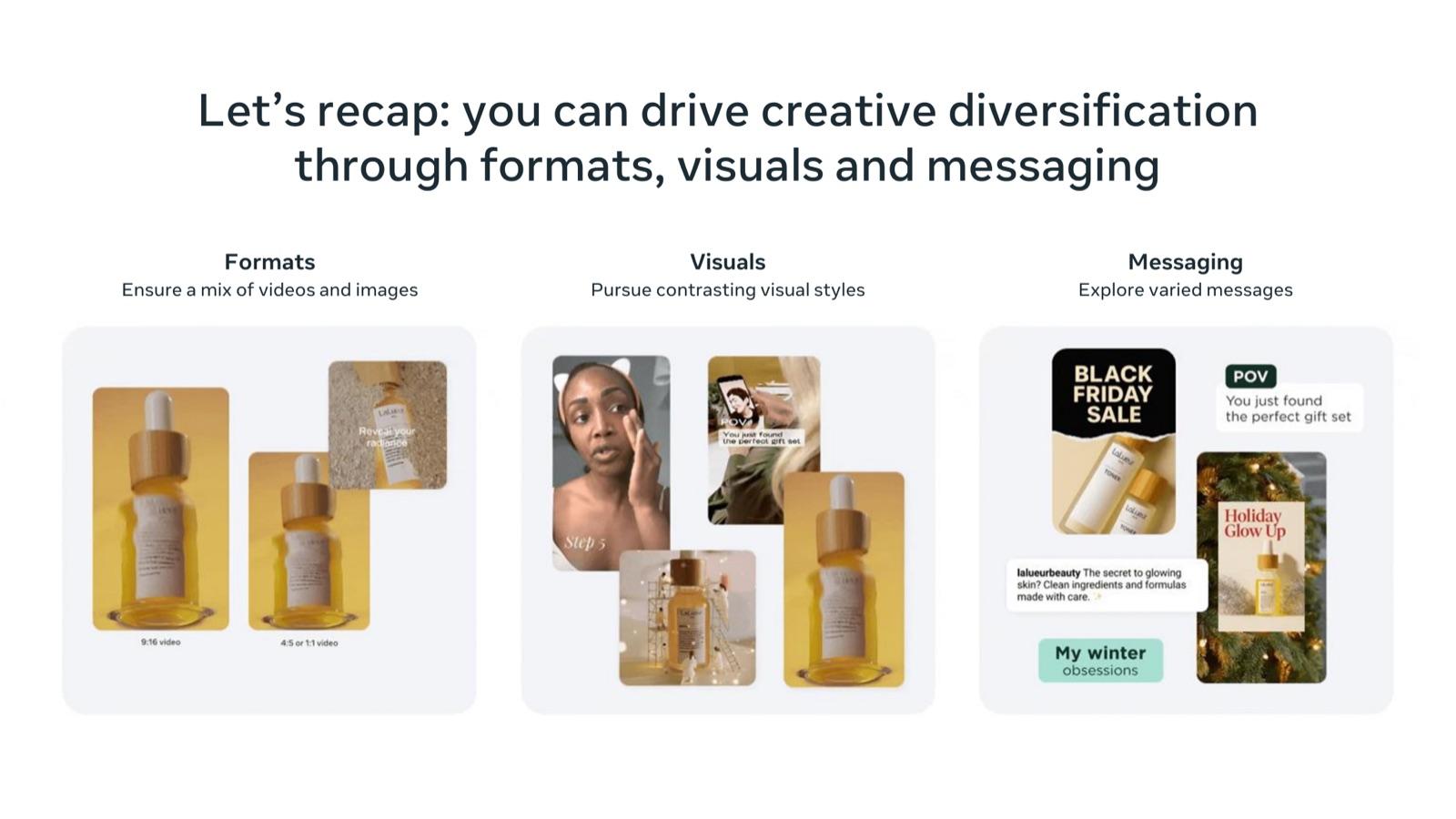
Meta calls this creative diversification: a mix of formats (video and image) and concepts (different visuals and different messages) at the ad set level. The playbook gives two reasons it works. It lets delivery match ads to people more precisely, and it slows creative fatigue, the rise in cost that comes when the same people see the same ad too often.
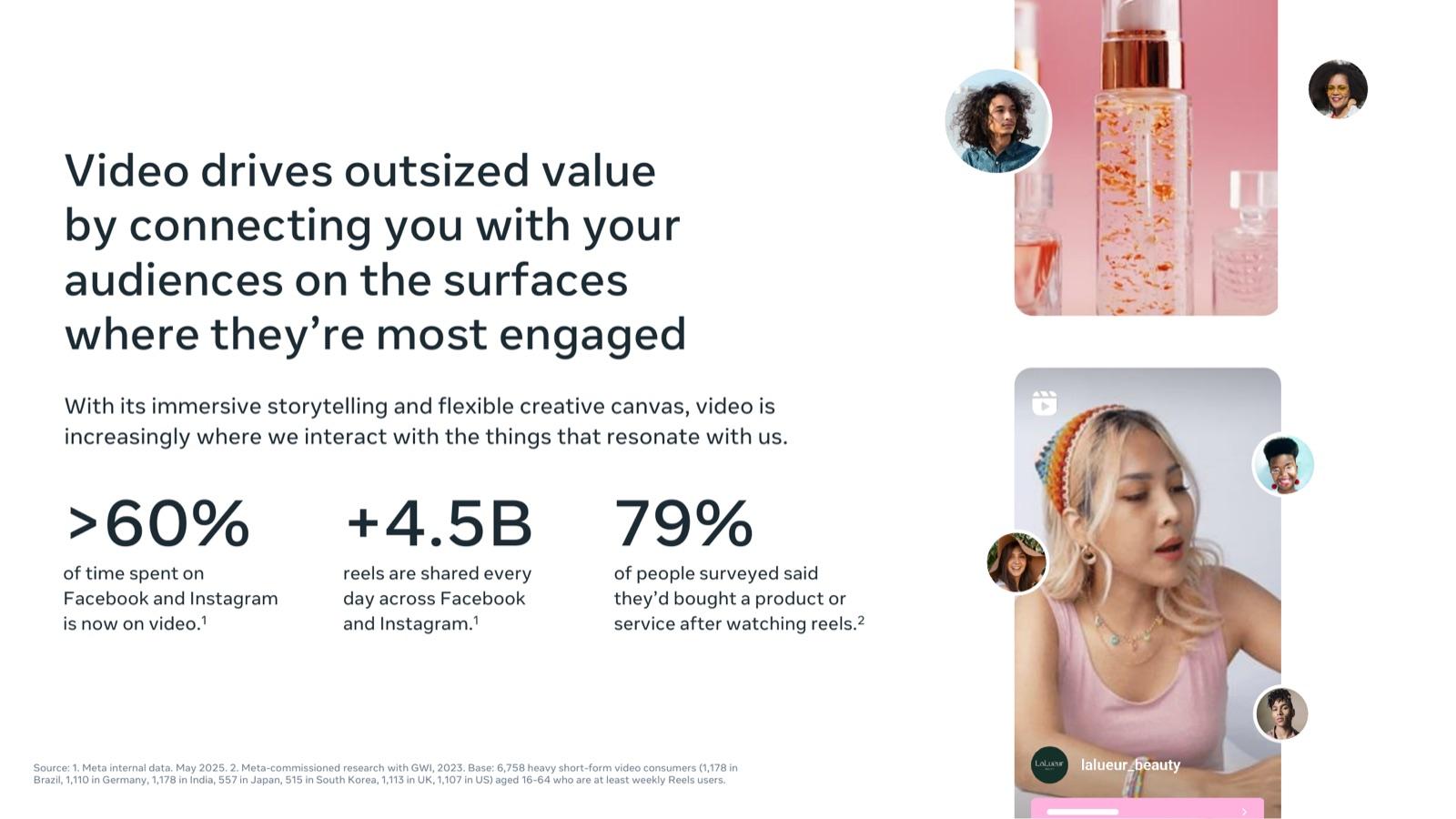
Three ways to make ads different
| Lever | What changes | Examples from the playbook |
|---|---|---|
| Format | Video vs image, and aspect ratio | 9:16 video with audio, 4:5 or 1:1 video, 1:1 or 4:5 image |
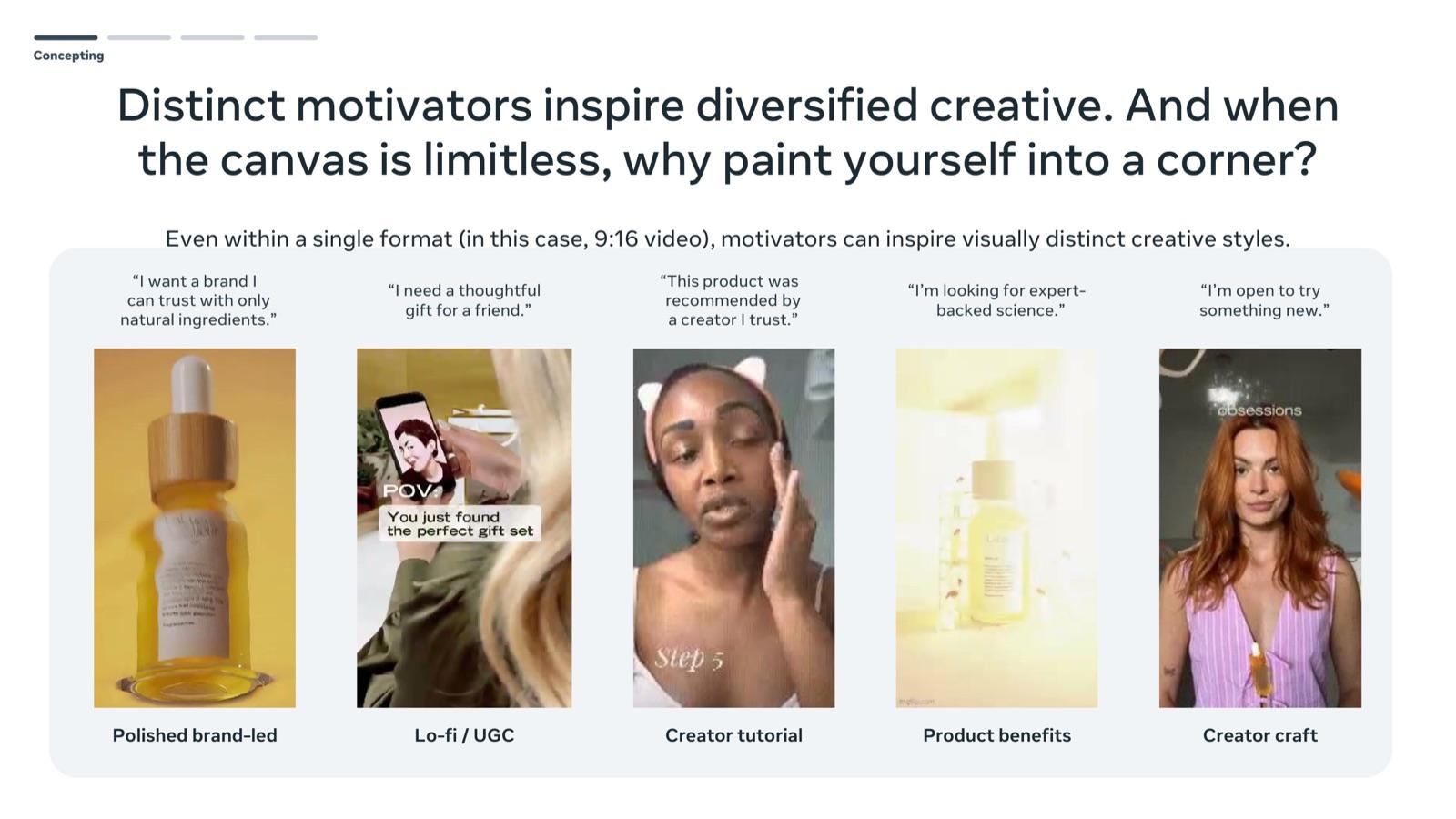
| Visual style | How the ad looks | Polished and brand-led, lo-fi or UGC, product-focused, creator-made, animation or illustration |
| Message | What the ad says | Motivators and barriers, emotional benefits, functional benefits, product use or demo, deals and sales |
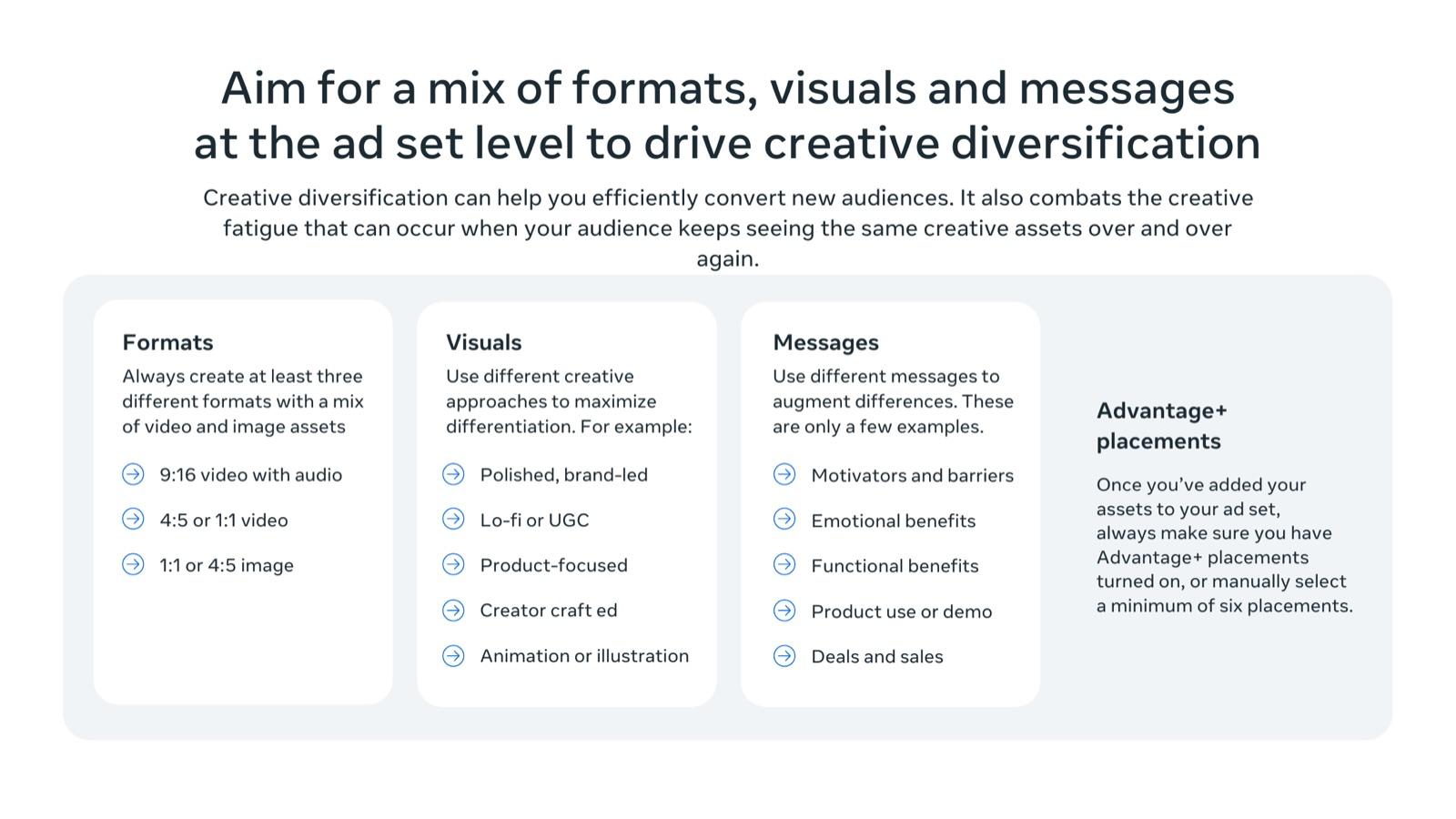
Two 9:16 videos with the same look and the same message count as one idea. A 4:5 image and a 9:16 video with different visuals and different messages count as two. The playbook's diagrams make this point directly: the most diverse ad set changes all three levers at once.
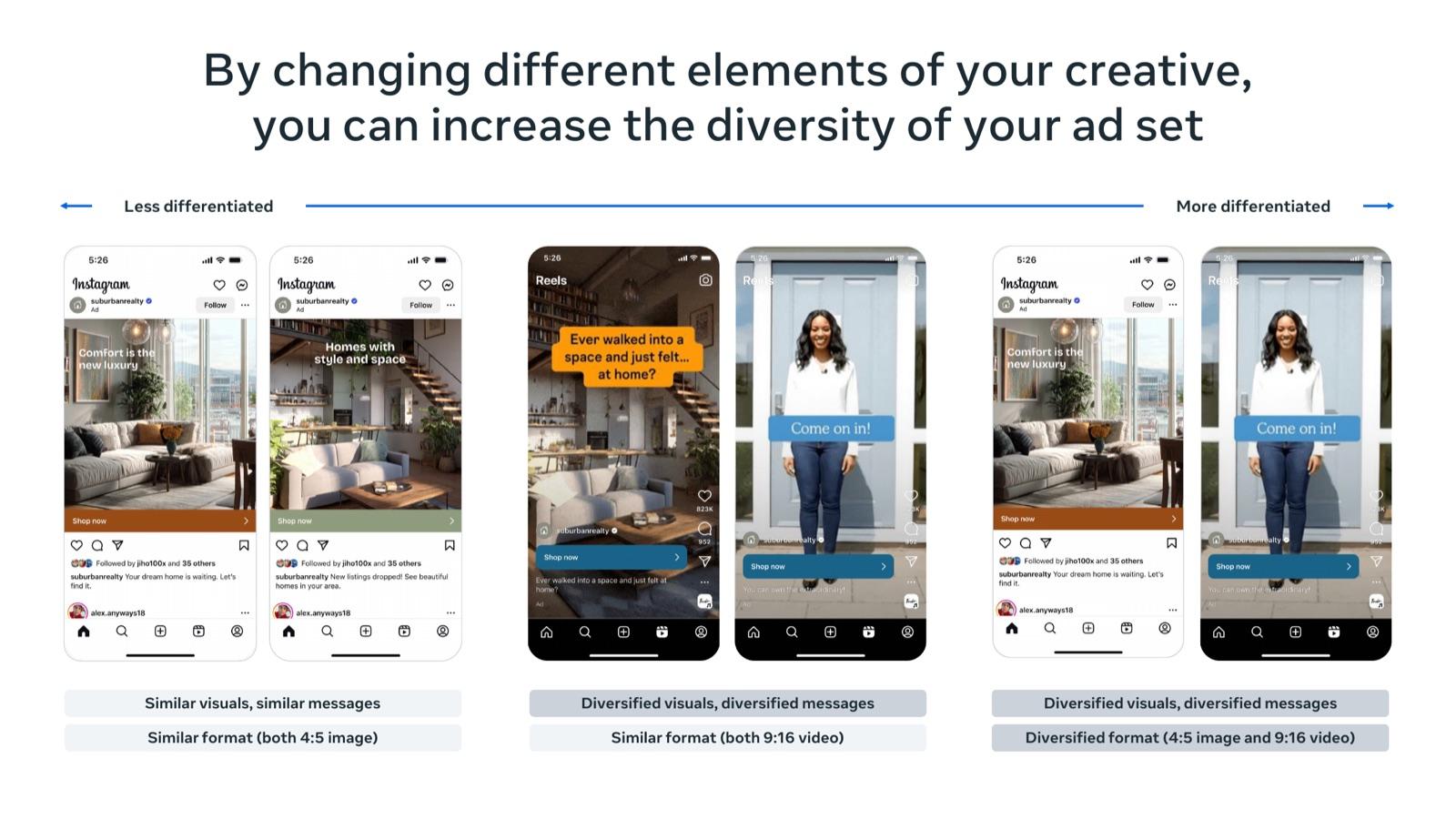
The minimum format mix
9:16 video with audio
At least 20% of the ad set
4:5 or 1:1 video
Feed and Stories
4:5 or 1:1 image
Pulled from a video key frame works
Plus Advantage+ placements, or at least six placements selected by hand.
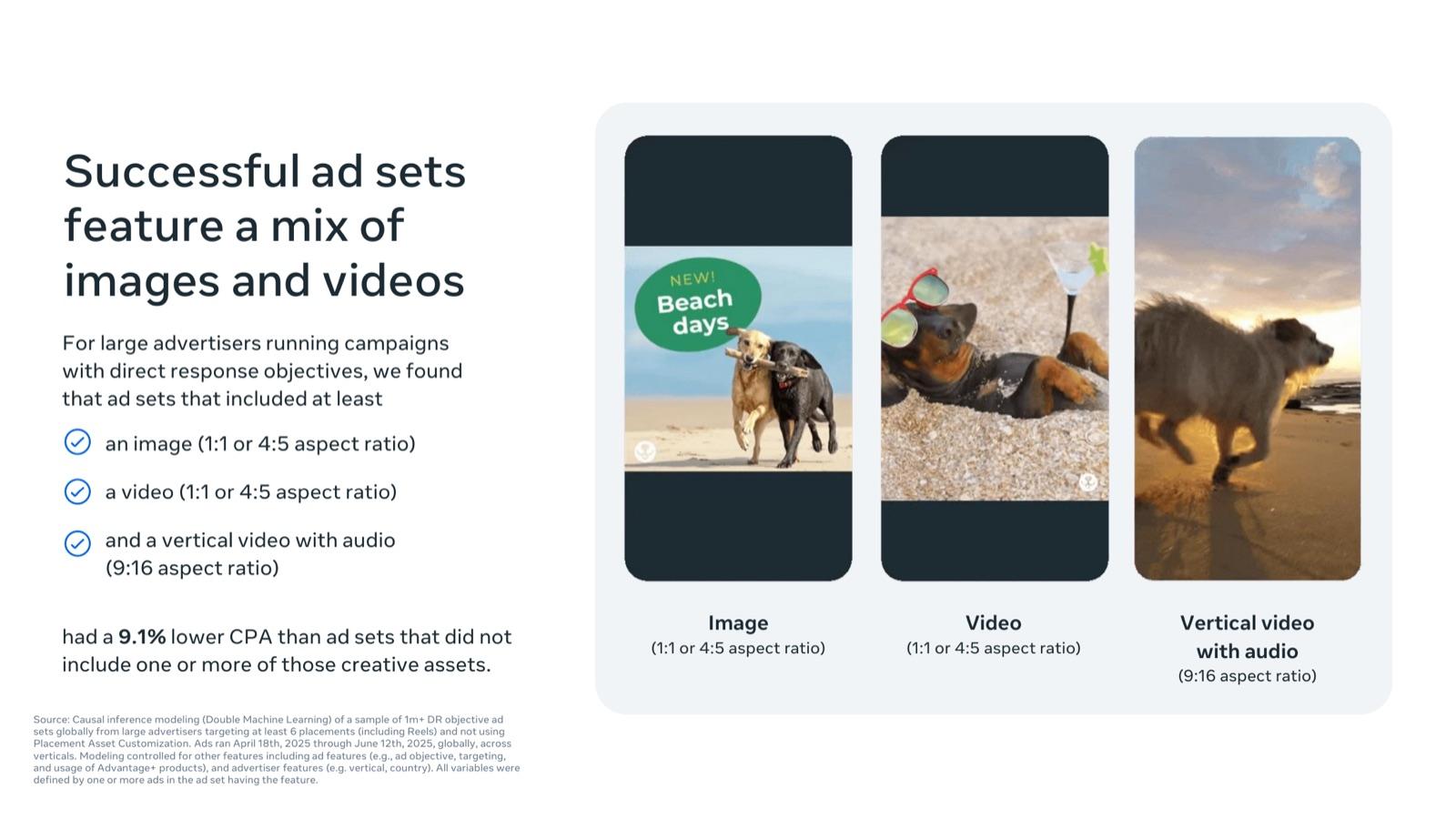
Meta reports that, for large advertisers running direct-response campaigns, ad sets containing an image (1:1 or 4:5), a video (1:1 or 4:5) and a vertical 9:16 video with audio had a 9.1% lower cost per result than ad sets missing one of them. That figure comes from Meta's causal-inference modelling of more than a million ad sets that ran between April 18 and June 12, 2025.
Meta also reports that ad sets where at least 20% of assets were 9:16 video with audio had a 7% lower cost per result than ad sets below that share, and that ad sets led by 9:16 video, then images, then other video saw 3% more incremental conversions.
Placements
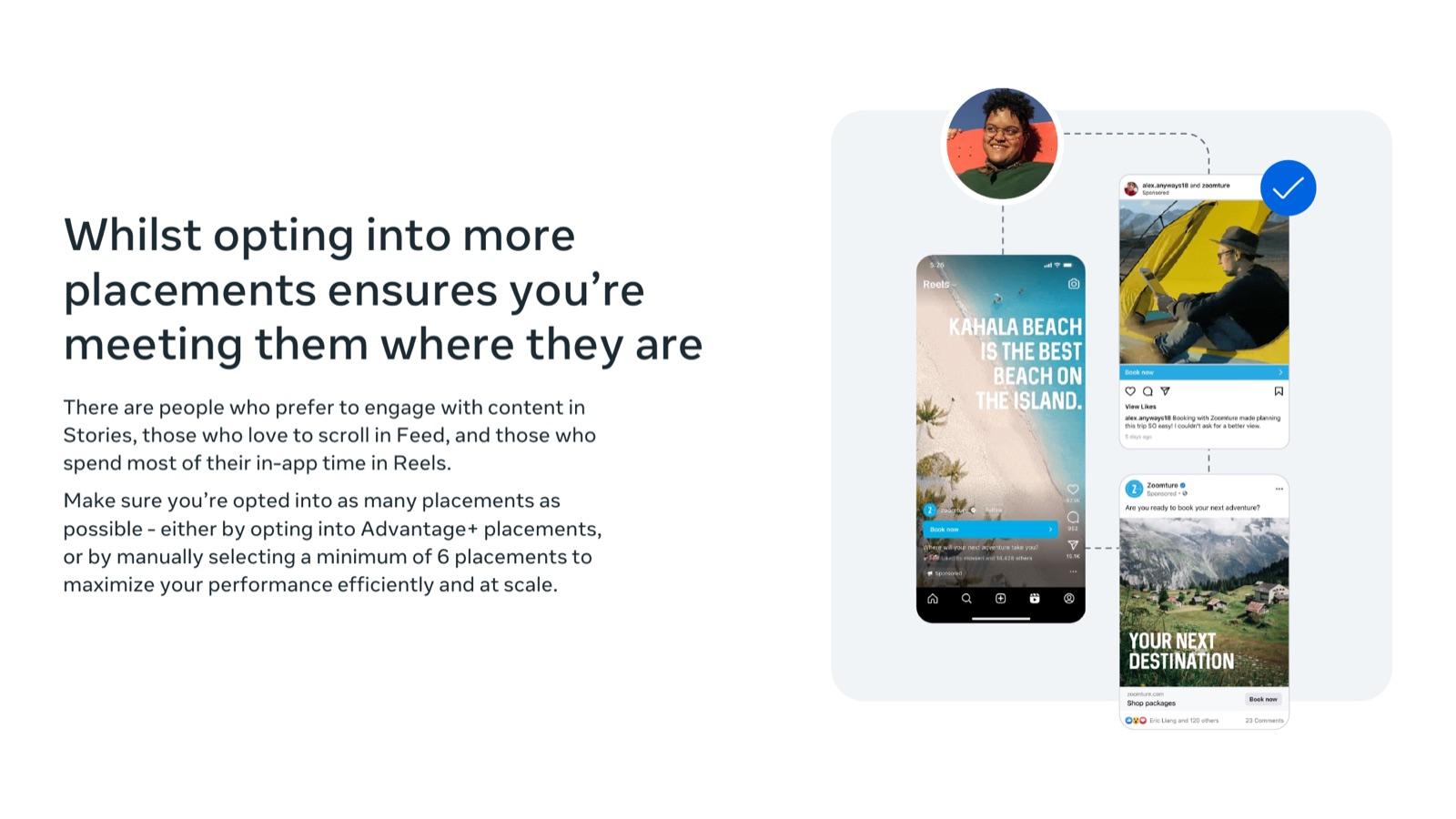
The playbook asks advertisers to turn on Advantage+ placements, or to select at least six placements by hand. Each placement has people who prefer it: some scroll Feed, some watch Reels, some tap through Stories. Fewer placements means fewer people your best ad can reach.
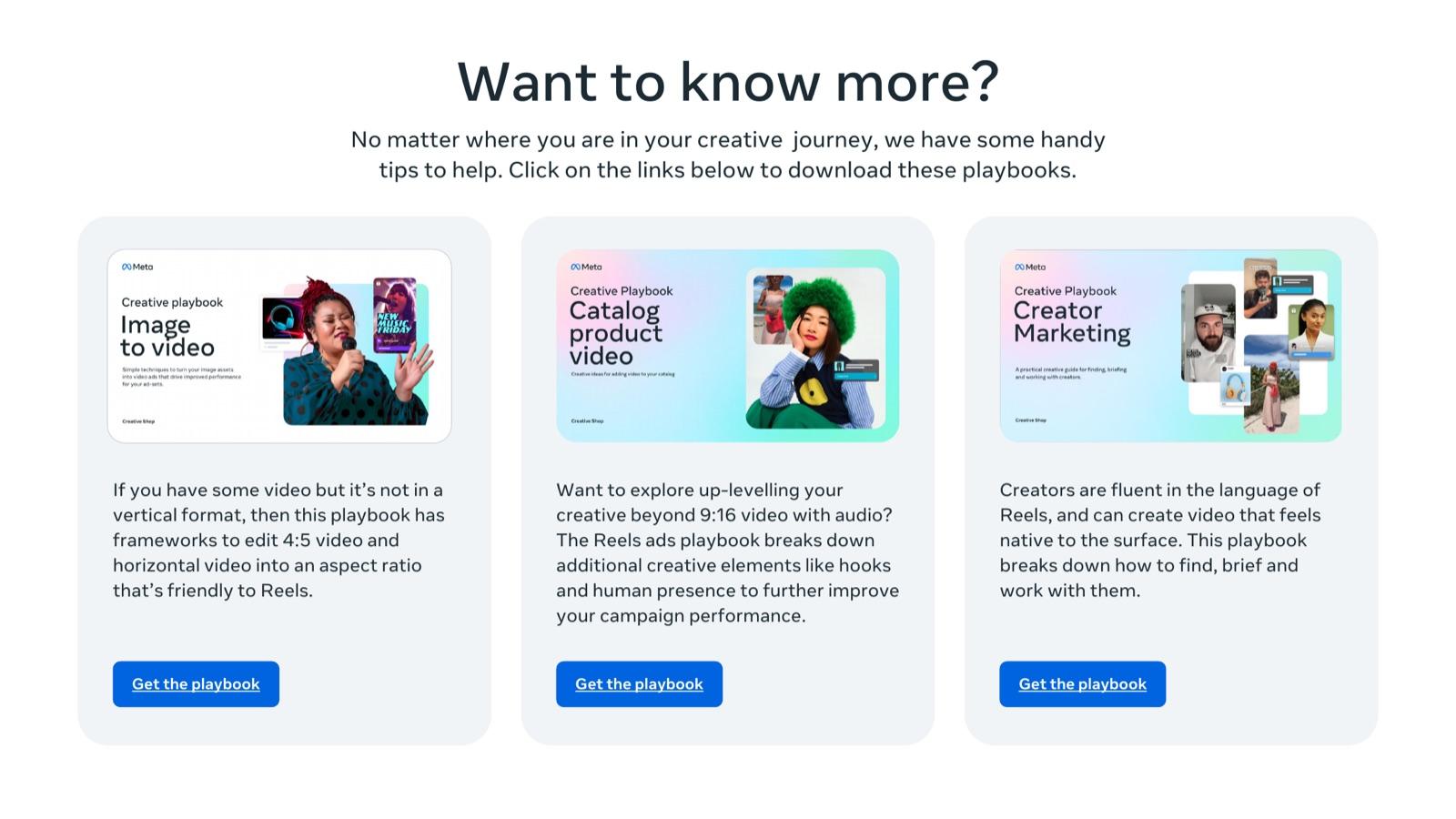
Catalog ads need video too
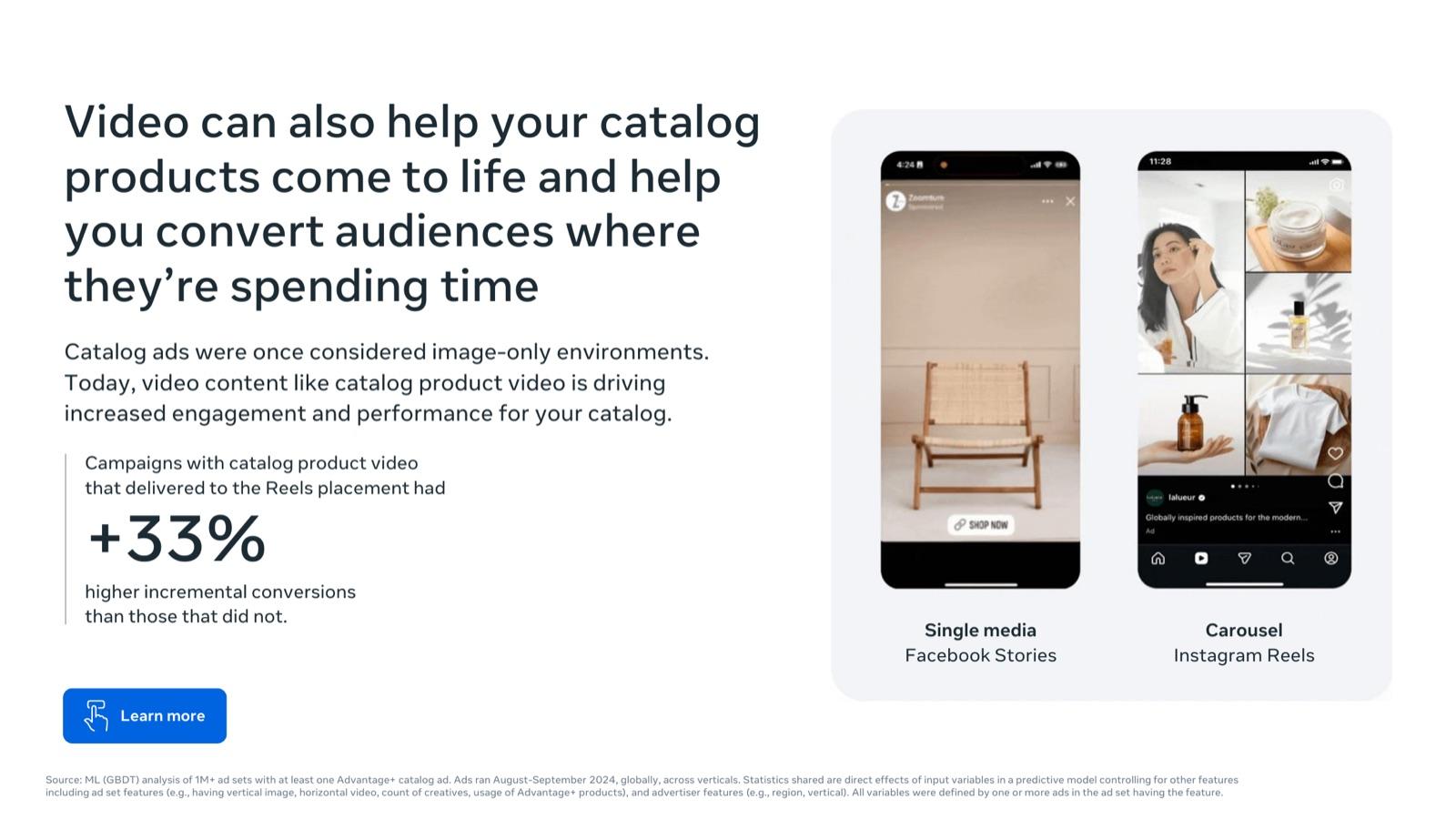
Catalog ads used to be image-only. Meta now reports that campaigns using catalog product video that delivered to Reels saw 33% more incremental conversions than those that did not (Meta analysis of more than a million ad sets with an Advantage+ catalog ad, August to September 2024). If you have a product video, add it to the product in your catalog.
Section 2: what a strong video ad and image ad look like
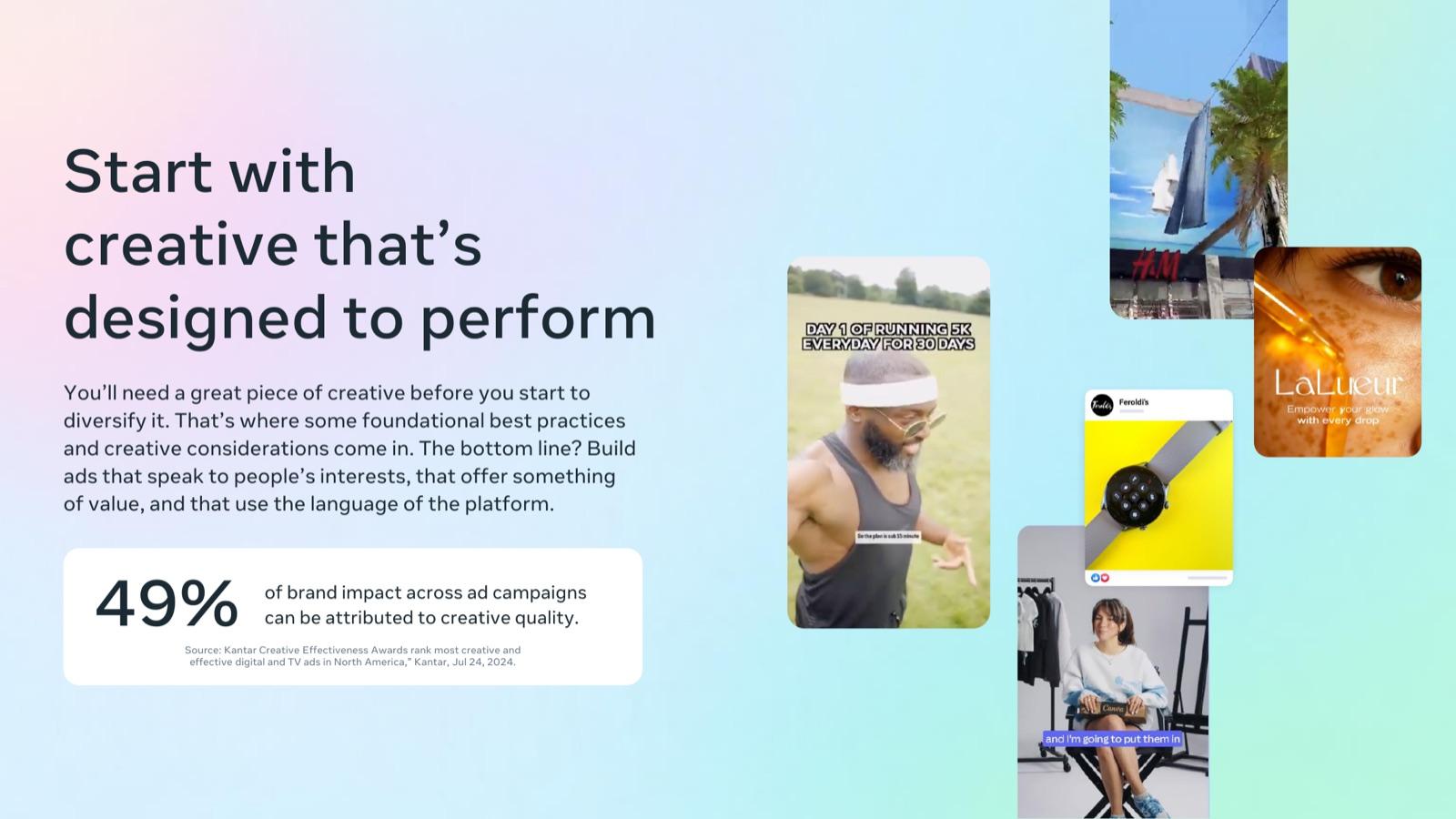
Diversifying weak ads does not help. The playbook's second section sets the bar for a single ad, and it quotes Kantar's finding that 49% of an ad campaign's brand impact can be attributed to creative quality.
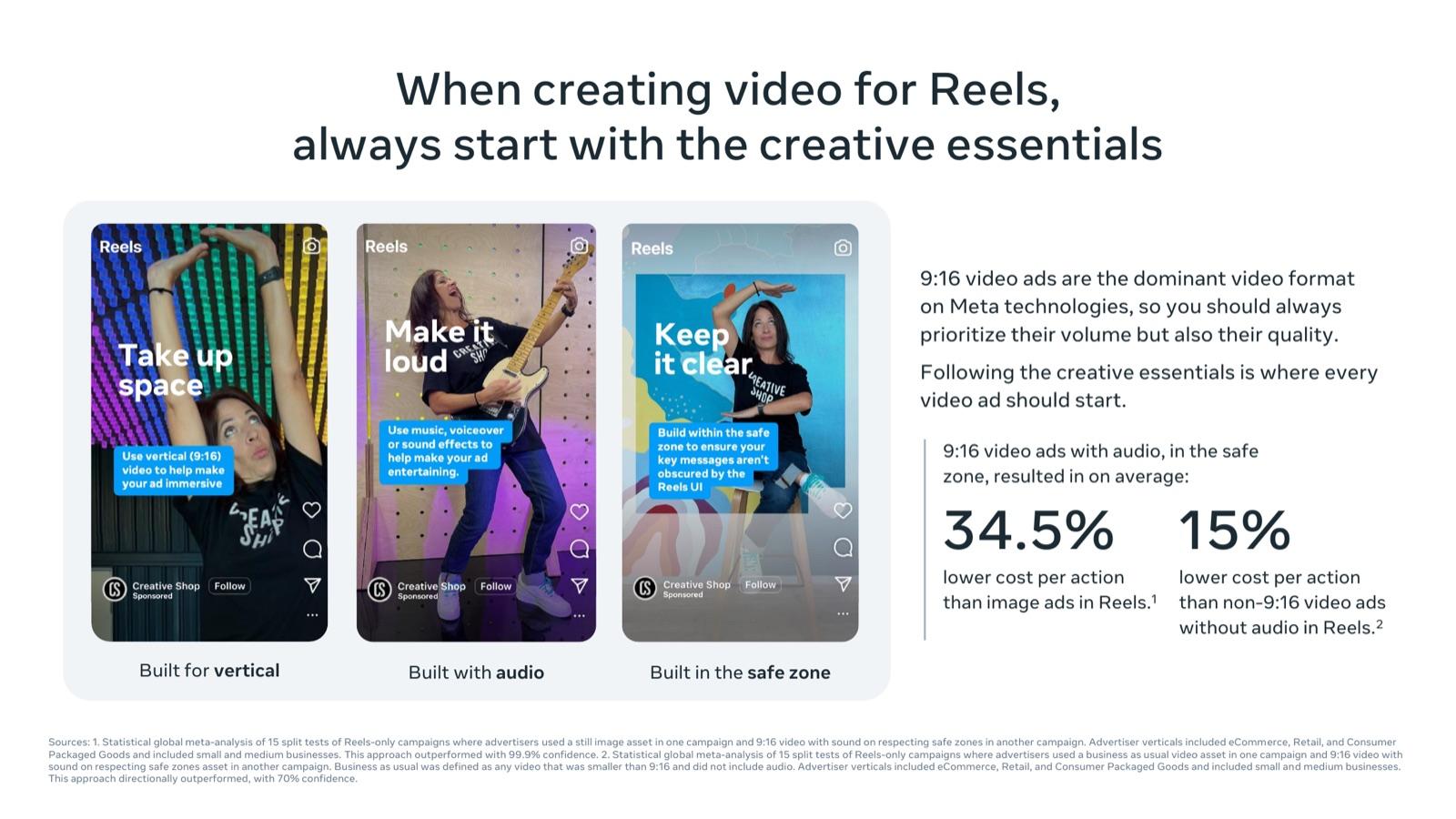
Video for Reels: the three essentials
- Built for vertical. Shoot or edit to 9:16.
- Built with audio. Music, voice or sound, designed to be heard.
- Built in the safe zone. Keep text and faces out of the areas the Reels interface covers.
Meta reports two results from split tests of Reels-only campaigns: 9:16 video with sound inside the safe zone had a 34.5% lower cost per result than image ads in Reels, and a 15% lower cost per result than non-9:16 video without audio (Meta notes the second result at 70% confidence).
Then add the language of Reels
| Element | What Meta means |
|---|---|
| Hook | Use the first two seconds to earn attention, through audio, video or text. |
| Audio dynamism | Go beyond background music: voiceover, sound effects, a change in audio that holds attention. |
| Text overlays | Label and highlight the story. Keep text in the safe zone. |
| Human presence | Show real people: customers, creators or employees. |
| Visual techniques | Several fast shots for pace, or transitions such as match cuts. |
From ten lift studies run between April and May 2023, Meta reports that using at least one of these elements was associated with 13% higher return on ad spend, 16% lower cost per result, 29% higher conversion rate and 11% more reach compared with campaigns using only business-as-usual creative.
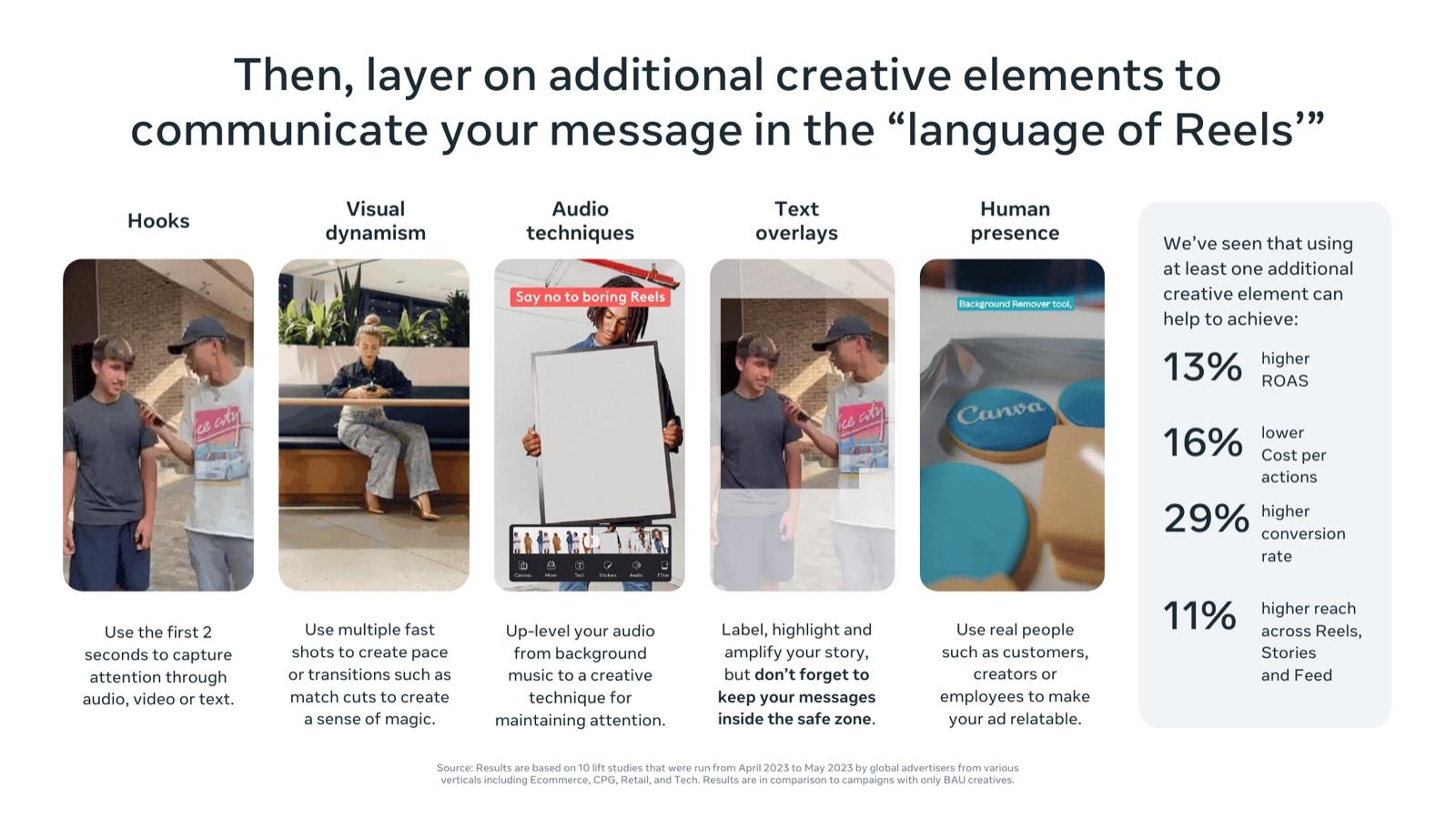
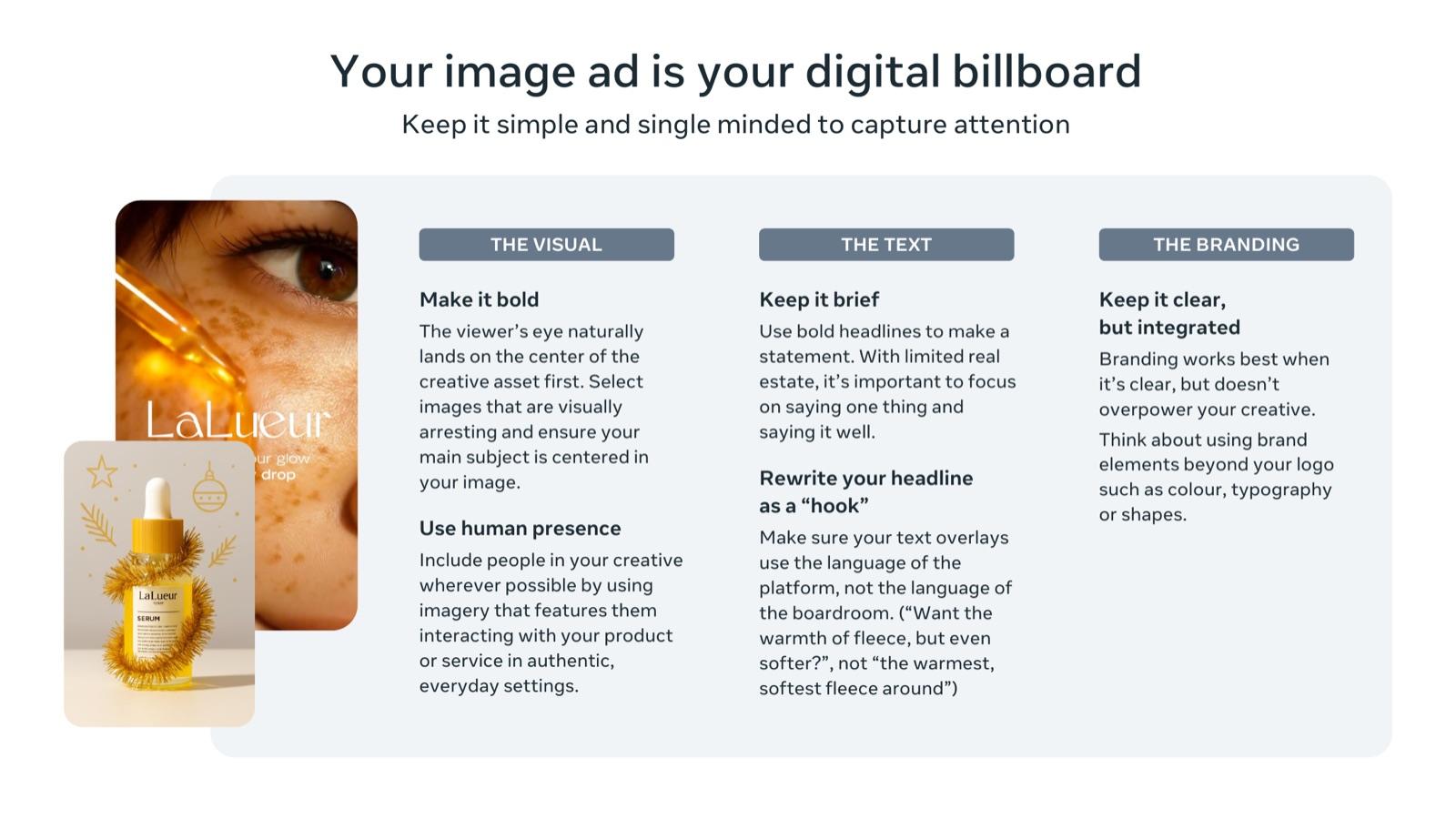
Image ads: treat them like a billboard
- Make the visual bold. The eye lands on the centre first, so put the main subject there.
- Show people. People using the product in everyday settings.
- Say one thing. A short, bold headline.
- Write the headline as a hook, in the language of the feed. Meta's example: "Want the warmth of fleece, but even softer?" instead of "the warmest, softest fleece around".
- Brand clearly, but not loudly. Use colour, type and shapes as well as the logo.
Section 3: from one-off ads to a creative operating system
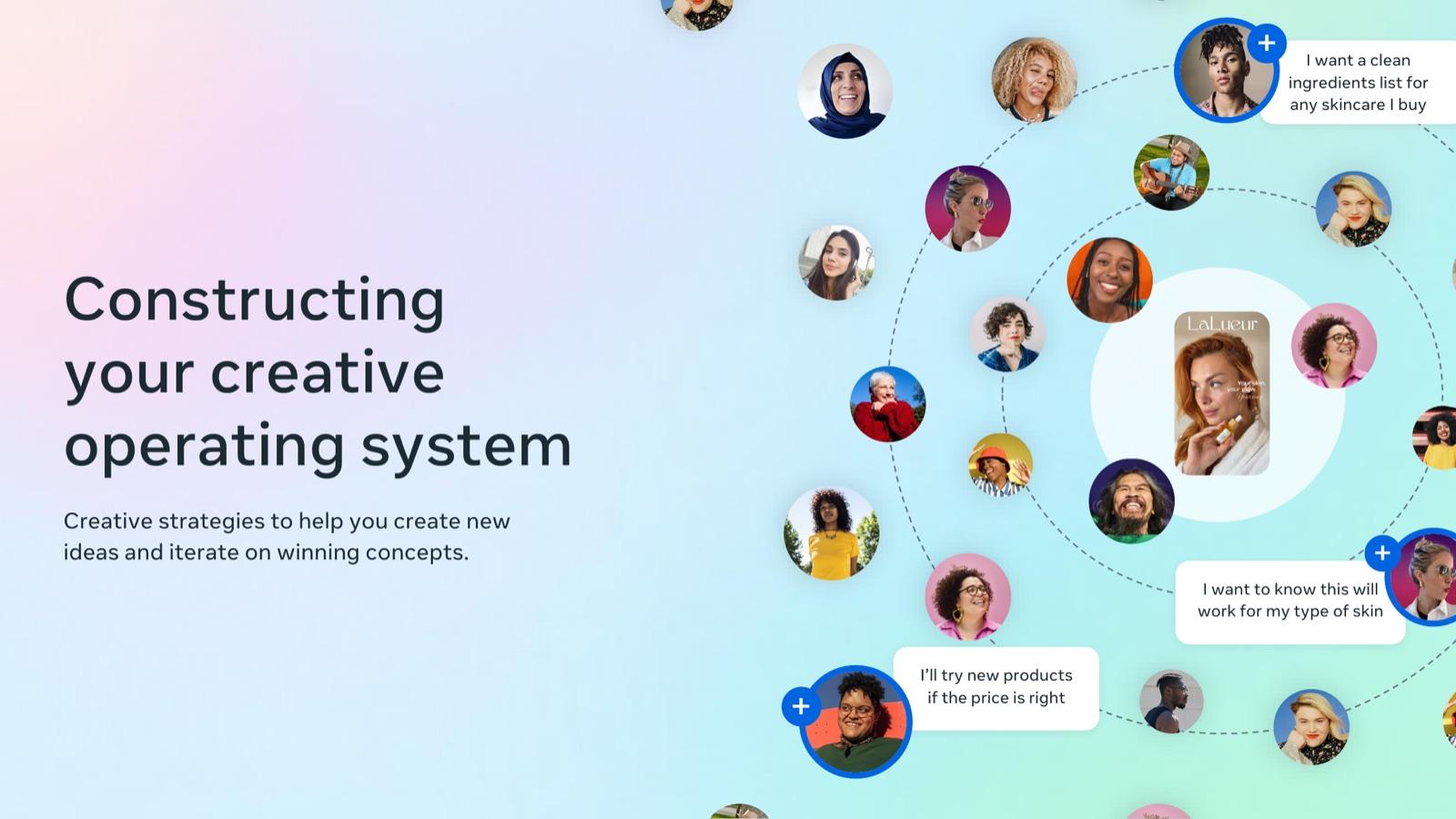
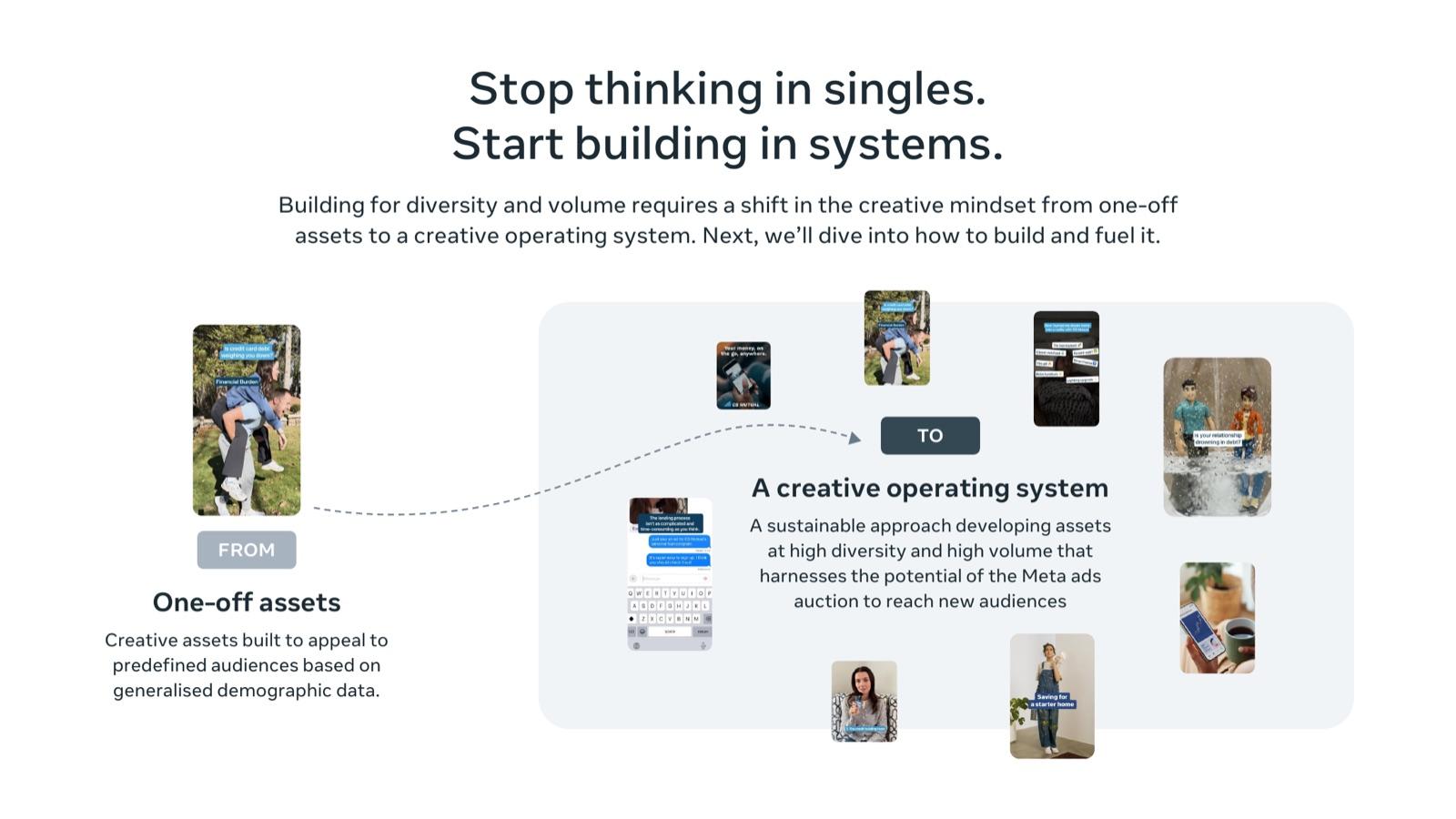
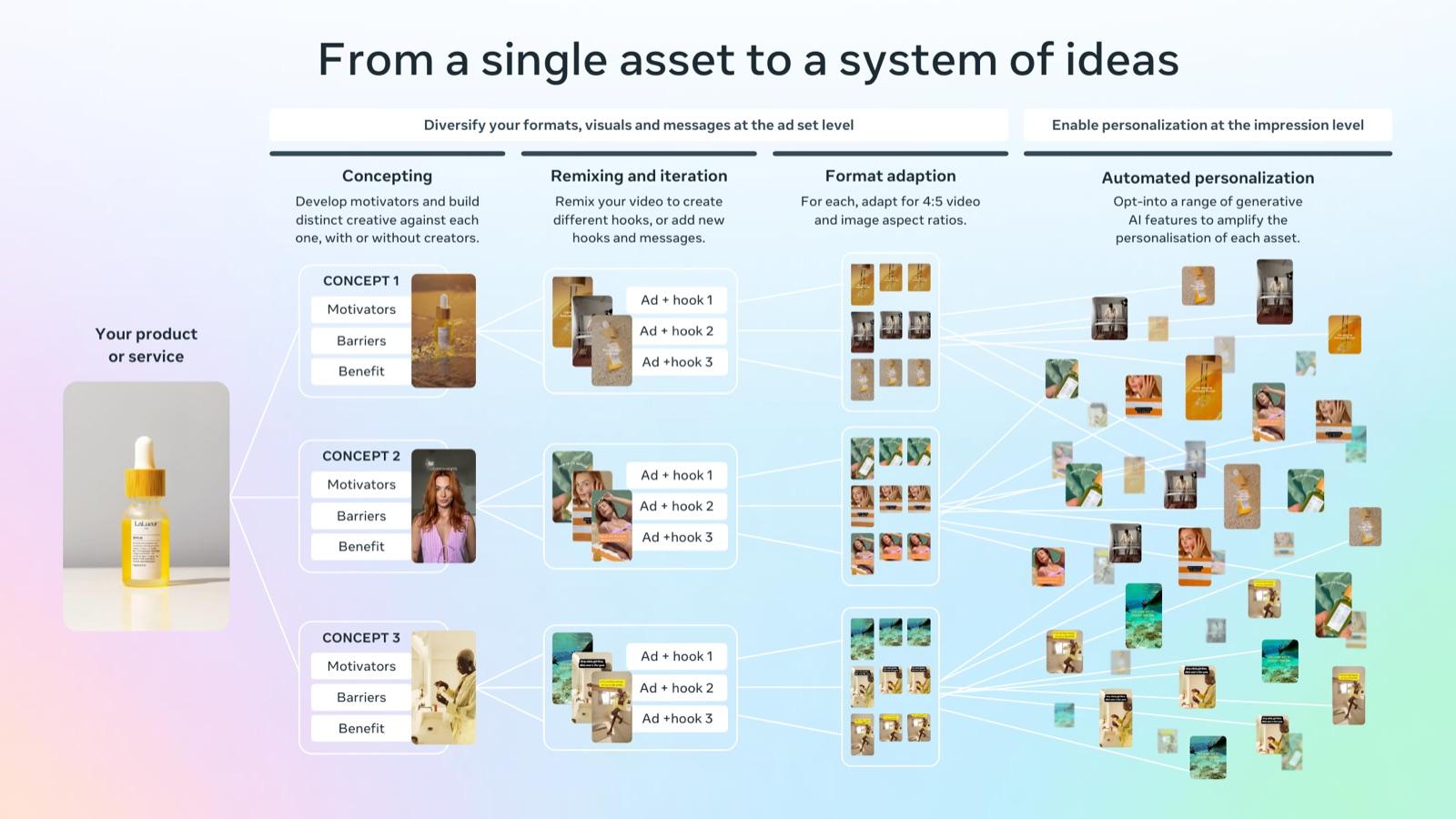
The second half of the playbook starts with a change of mindset. Instead of producing single assets for a predefined audience, Meta asks advertisers to run a system that produces many different assets continuously. The system has four stages.
| Stage | What you do | Output |
|---|---|---|
| Concepting | Write concepts from motivators, barriers and benefits | Two to three distinct concepts |
| Remixing and iteration | Film several hooks per video; recut winners | Several versions of each concept |
| Format adaptation | Turn each video into 4:5 video and images | Three formats per concept |
| Automated personalization | Opt in to Advantage+ creative features | Variations at the impression level |
Run it as a loop. Each week, new concepts feed in, the best performers get remixed, and every asset ships in three formats.
Section 4: concepting with motivators
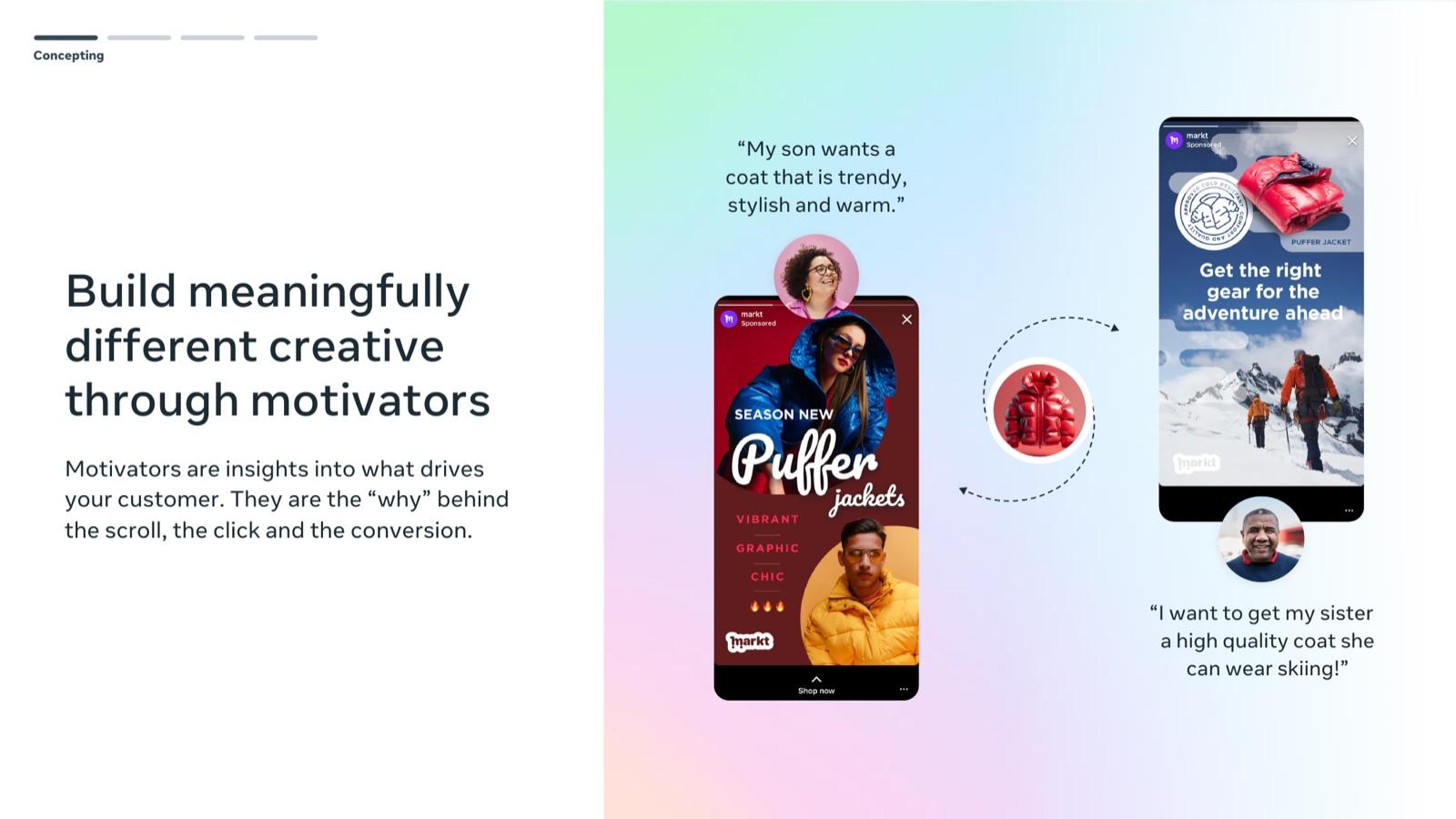
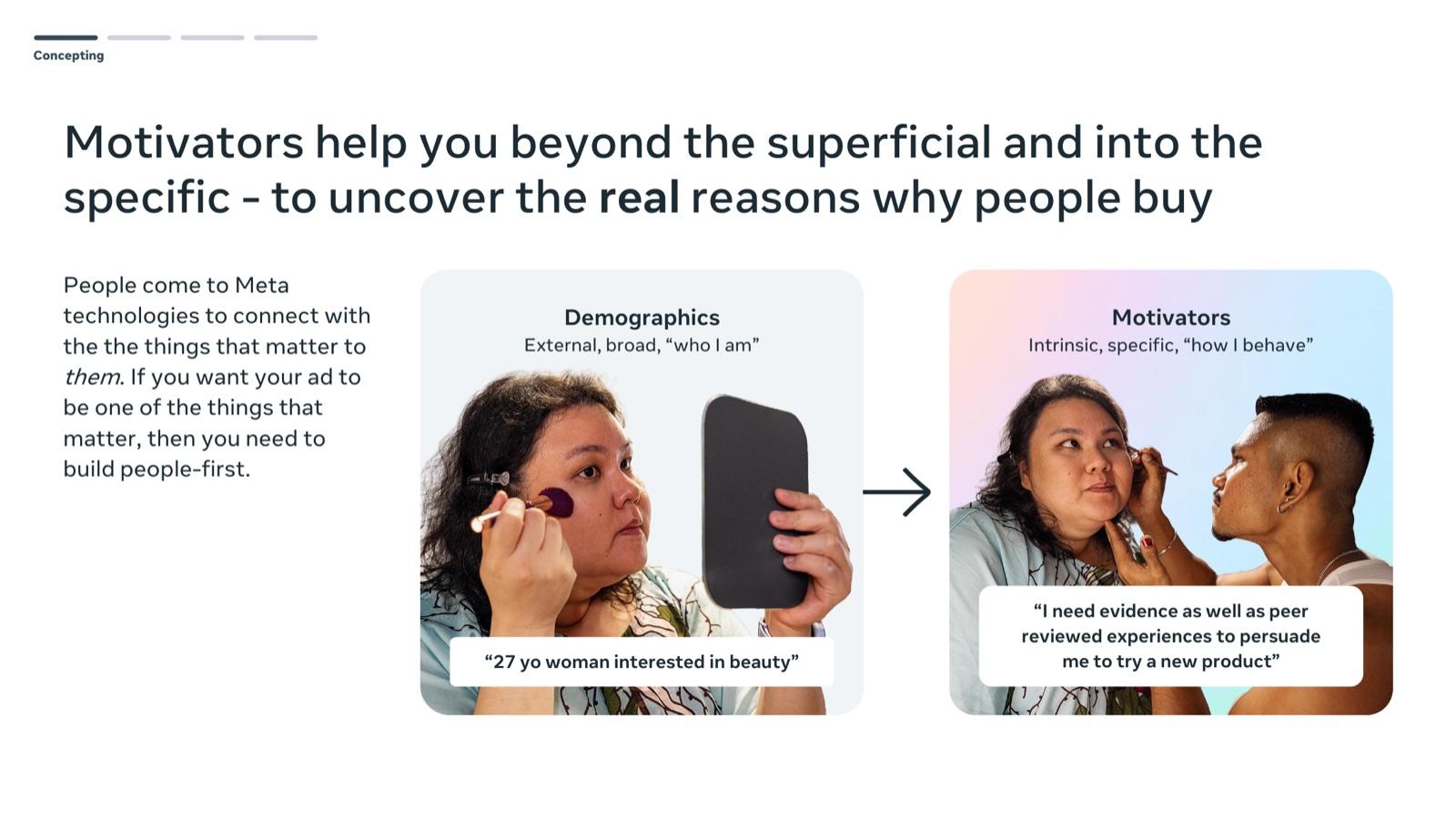
A motivator is the reason behind a purchase: the why behind the scroll, the click and the order. A barrier is the reason someone hesitates. The playbook contrasts the two ways of describing a customer:
| Demographic | Motivator |
|---|---|
| "27-year-old woman interested in beauty" | "I need evidence and reviews from people like me before I try a new product." |
The demographic tells you who to target. The motivator tells you what to show. One product can have several motivators, and each one becomes its own concept with its own look.
The motivator worksheet
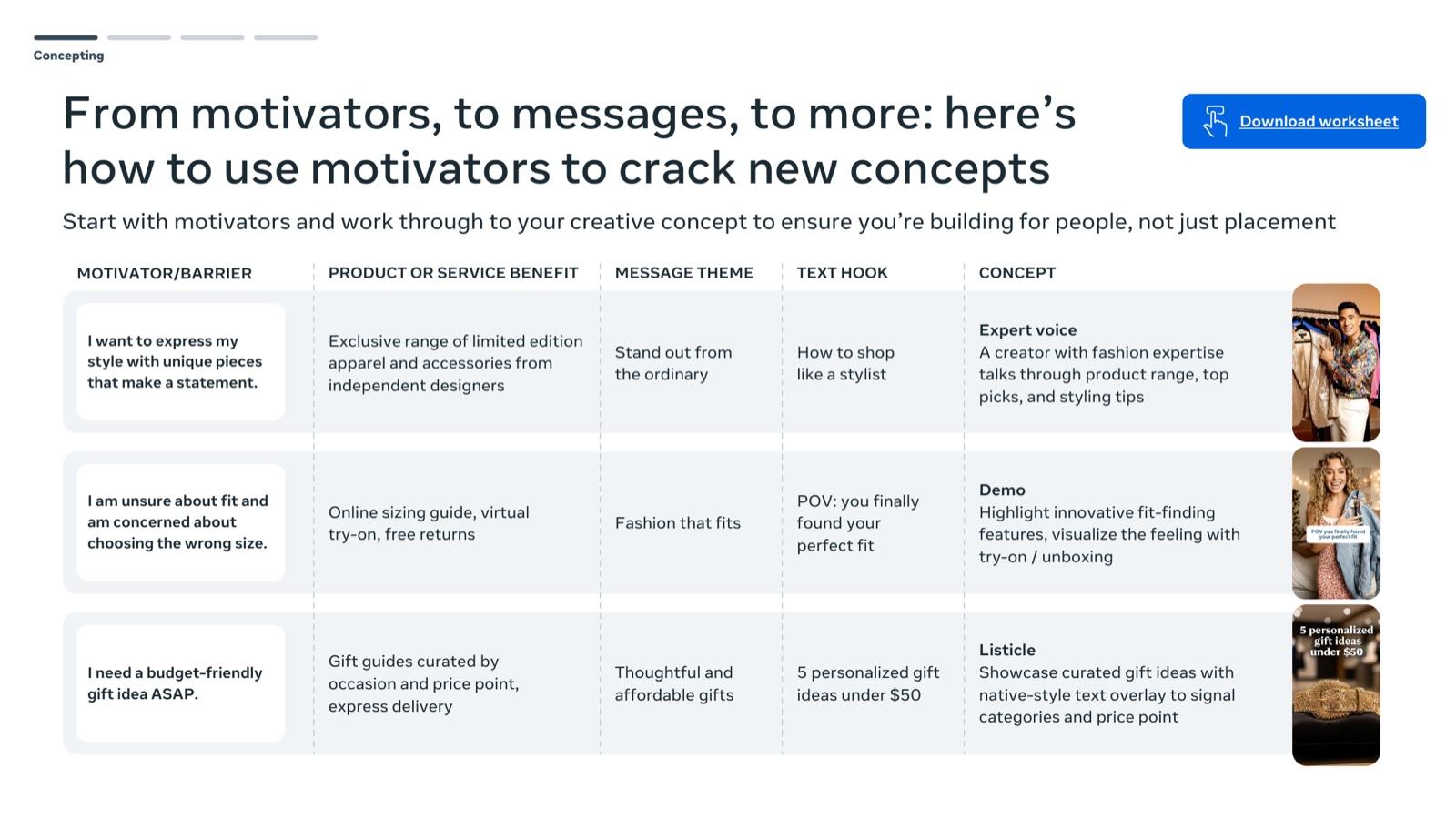
Meta's worksheet runs left to right: motivator or barrier, the product benefit that answers it, a message theme, a text hook, and the concept. Here is the same structure filled in for a Black Friday skincare offer (our example):
| Motivator or barrier | Benefit | Theme | Text hook | Concept |
|---|---|---|---|---|
| "I want to know it works on my skin type." | Dermatologist-tested on sensitive skin | Expert voice | "What a dermatologist actually uses on dry skin" | Creator dermatologist walks through the routine |
| "I only buy at a good price." | Black Friday bundle, 30% off | Deals | "The bundle I wait all year for" | Unboxing with the price on screen |
| "I need a gift, fast." | Gift set, ships in 2 days | Gifting | "3 gifts under $50 that look like more" | Listicle with native-style text overlays |
Where motivators come from
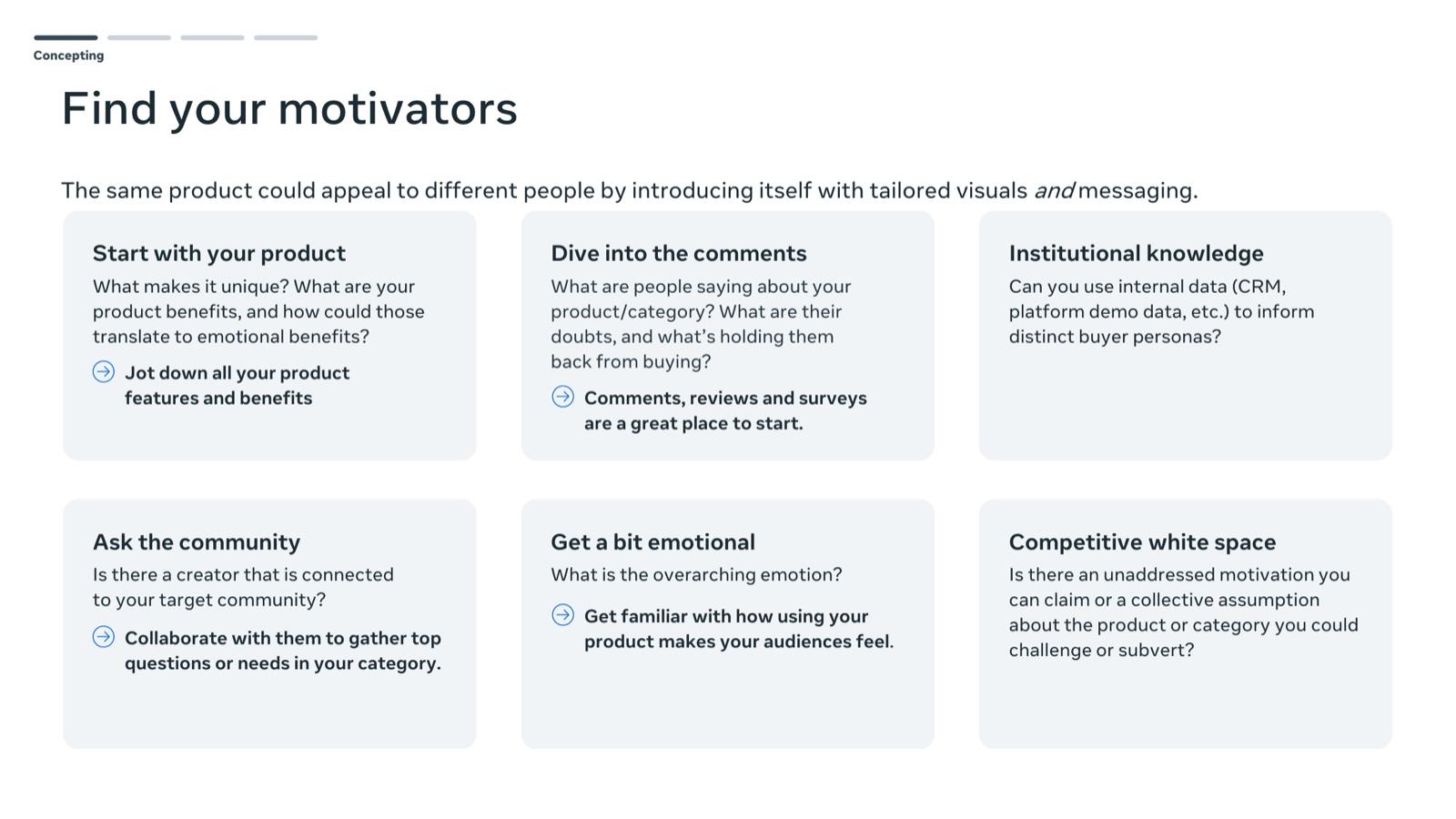
- Your product: list every feature, then the emotional benefit behind it.
- Comments, reviews and surveys: what people praise, and what stops them buying.
- Your own data: CRM and purchase data that separate buyer types.
- Creators in your community: ask them for the top questions in your category.
- The emotion: how using the product makes people feel.
- White space: a motivation no competitor has claimed.
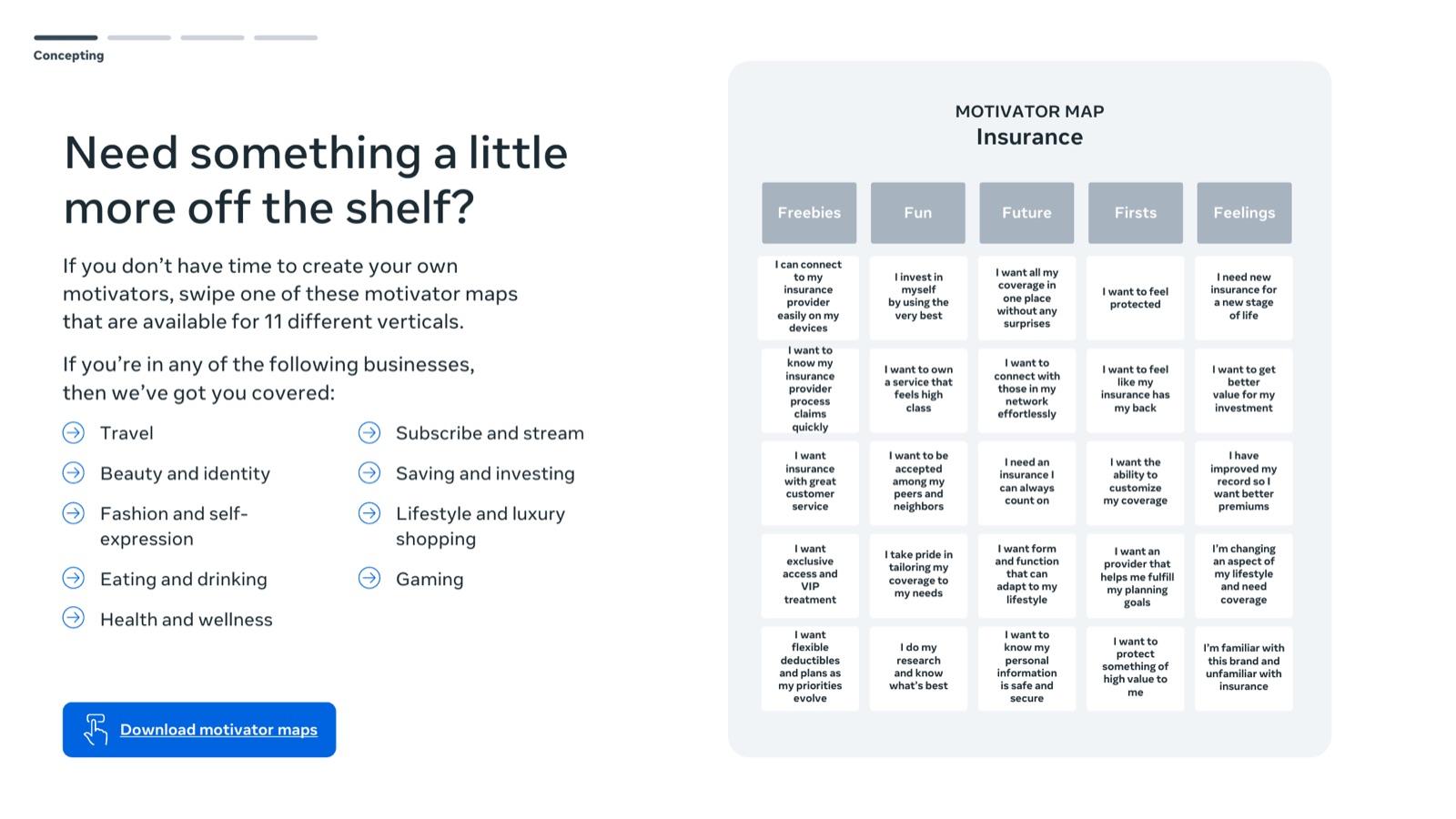
Meta also publishes ready-made motivator maps for 11 verticals, including health and wellness, beauty, fashion, food and drink, and travel.
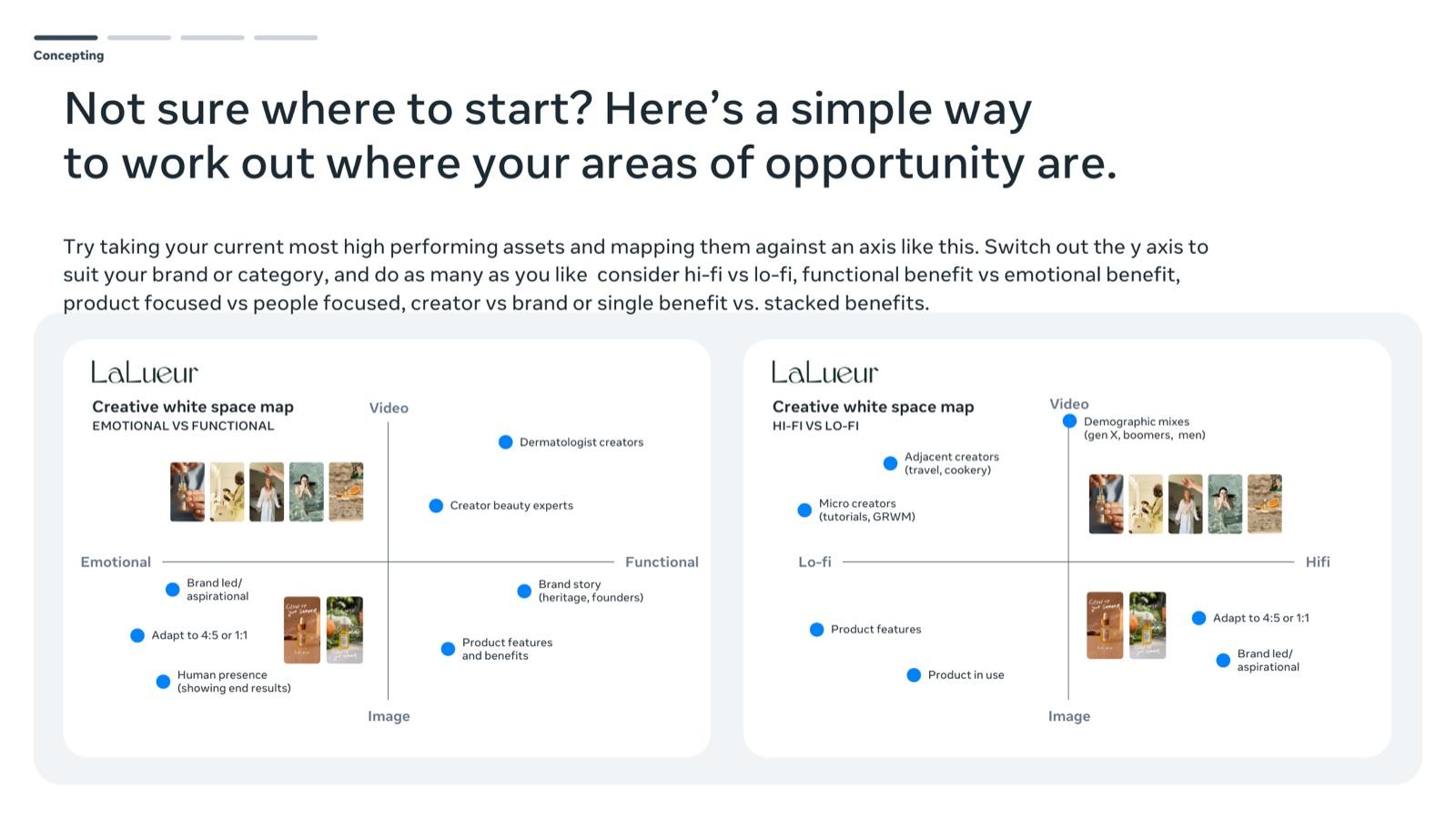
Map your current ads to find gaps
Plot your best-performing ads on two axes: emotional against functional, or polished against lo-fi, or product against people, or creator against brand. Empty quadrants are the concepts to make next.
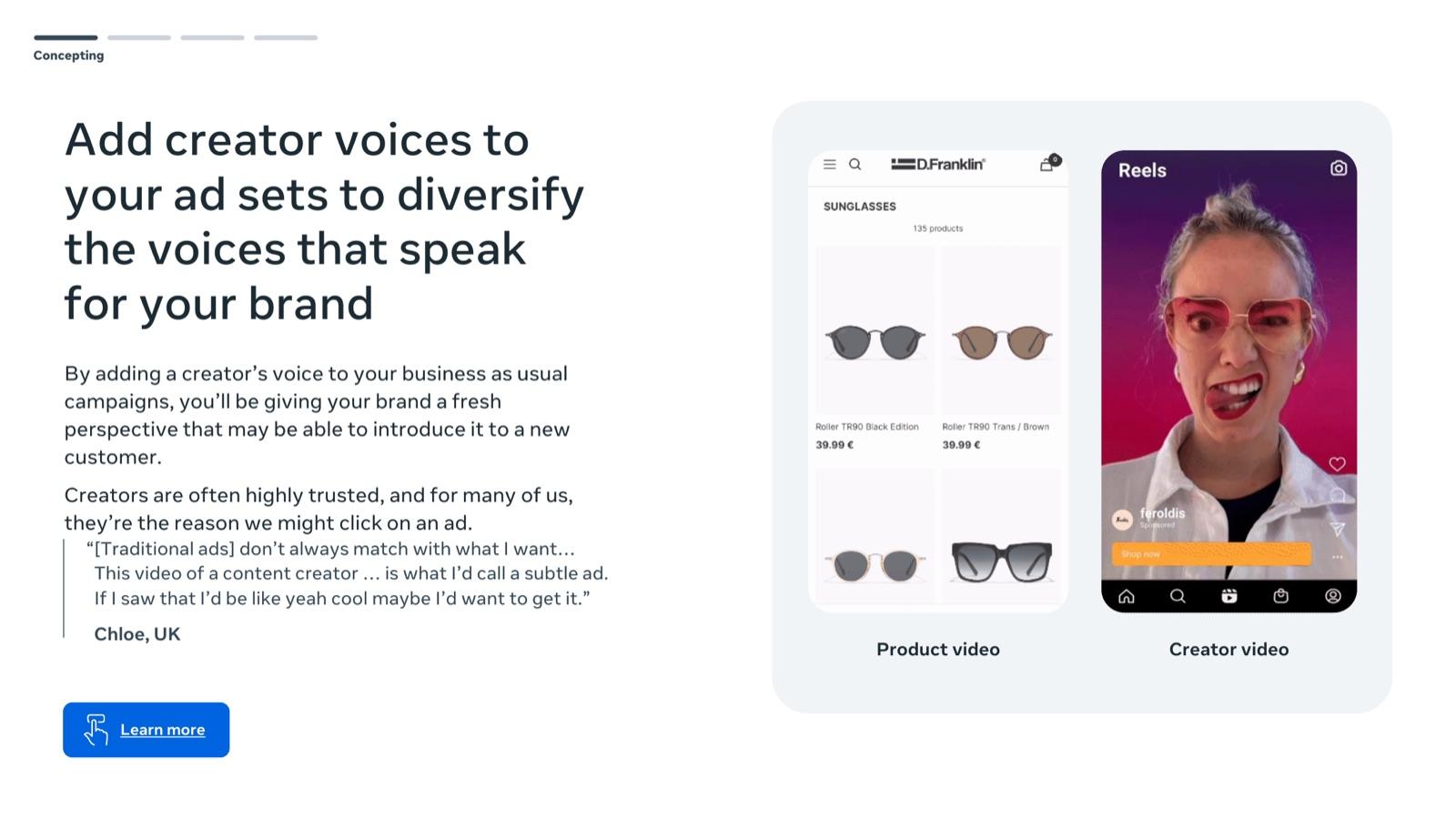
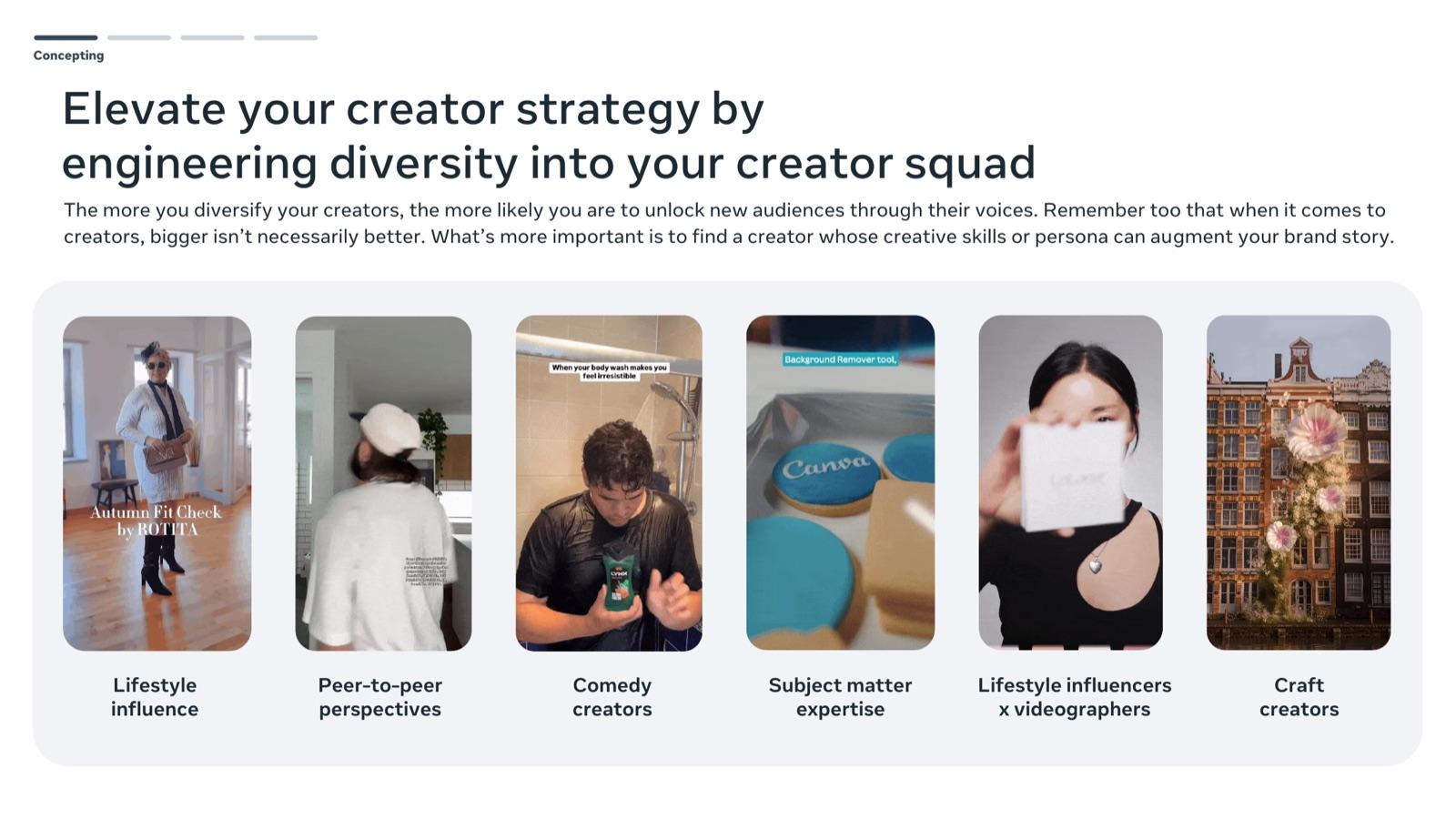
Add creator voices
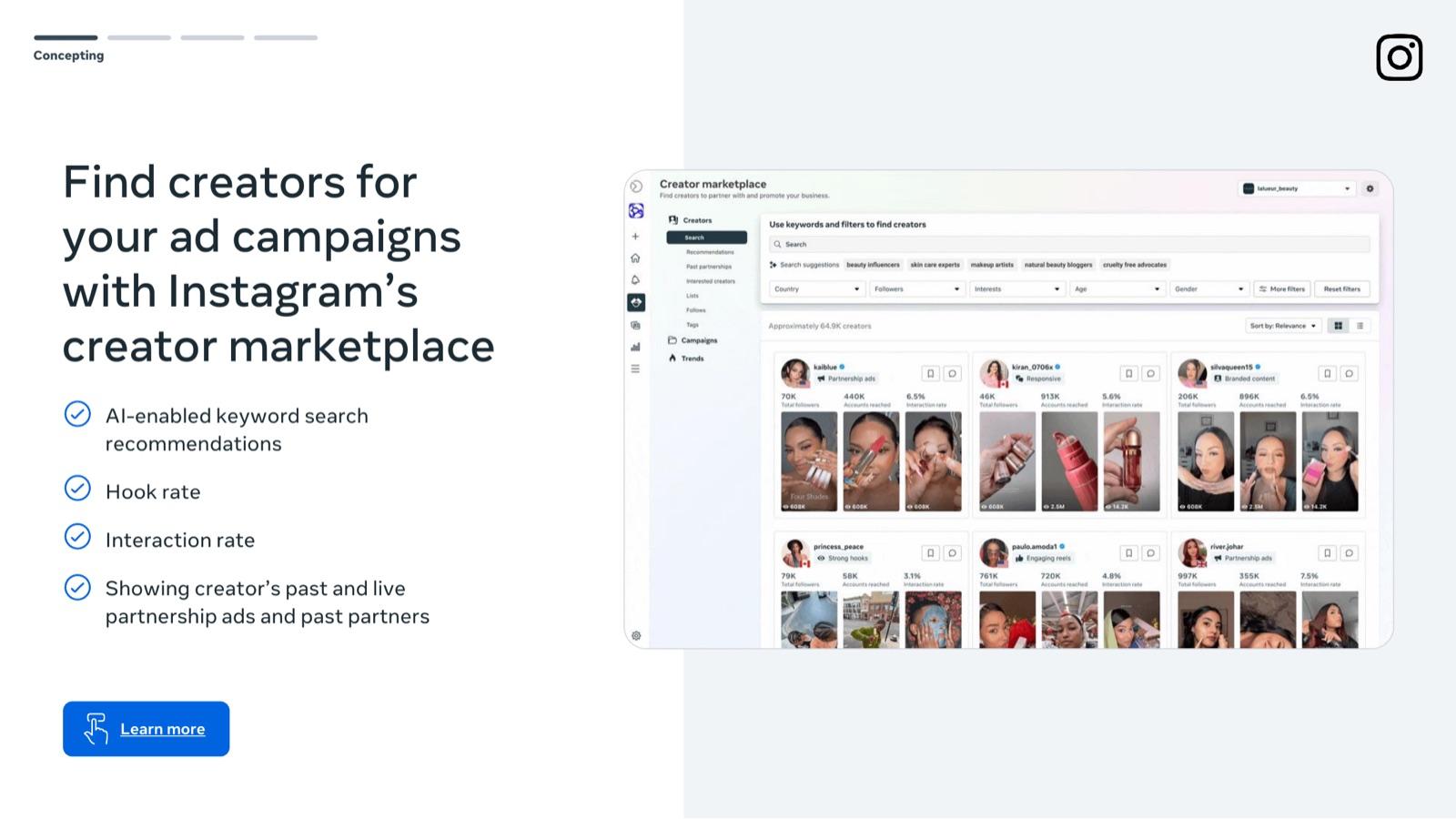
Creators speak the language of the feed and bring their own credibility. The playbook recommends mixing creator types (lifestyle, peer reviewers, comedy, subject experts, craft creators) rather than choosing by follower count, and points to Instagram's creator marketplace, which shows a creator's hook rate and interaction rate.
Section 5: remixing and iterating on winners
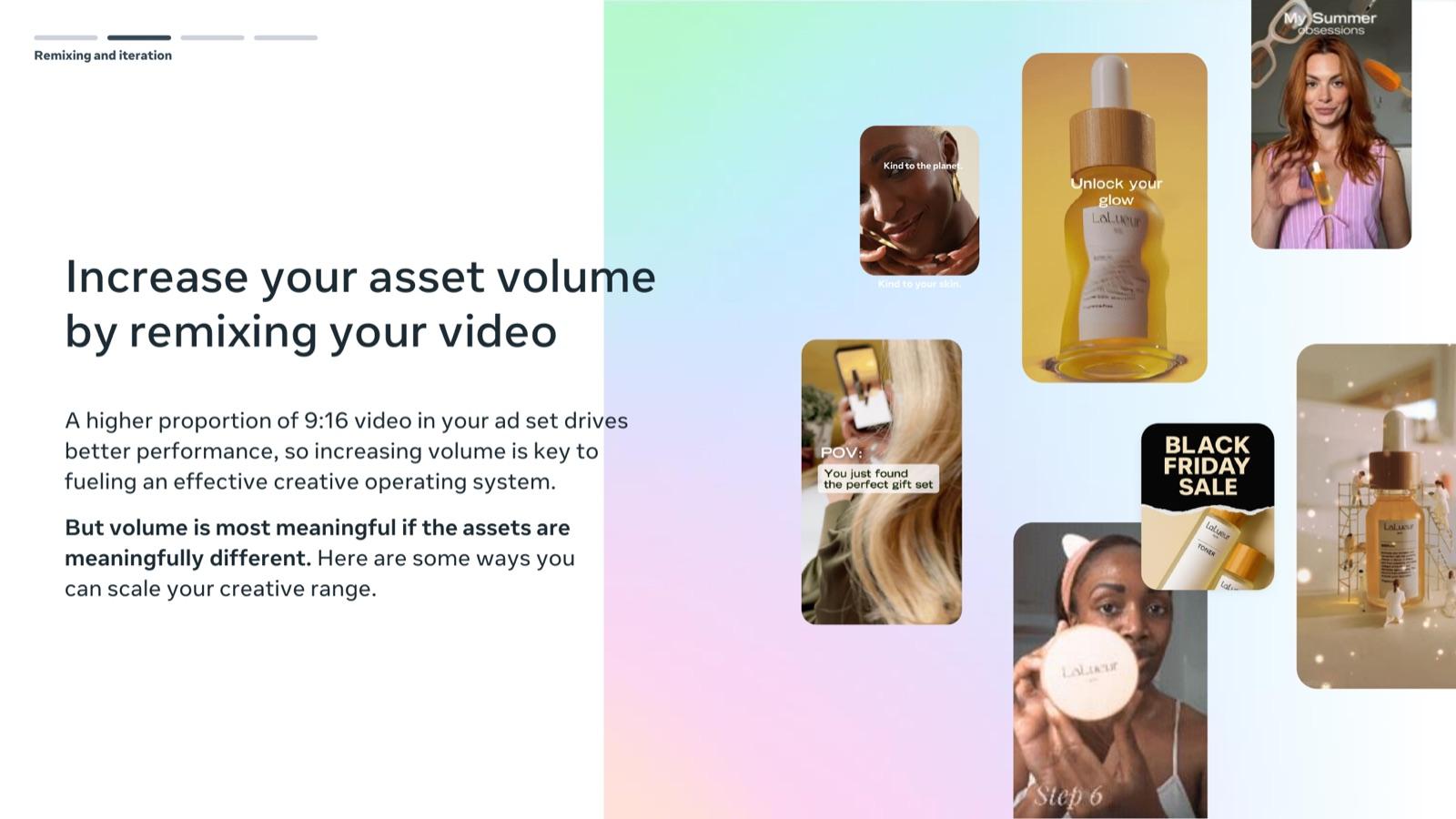
More 9:16 video helps, but only if the videos differ. This section shows how to get more distinct videos from footage you already have.
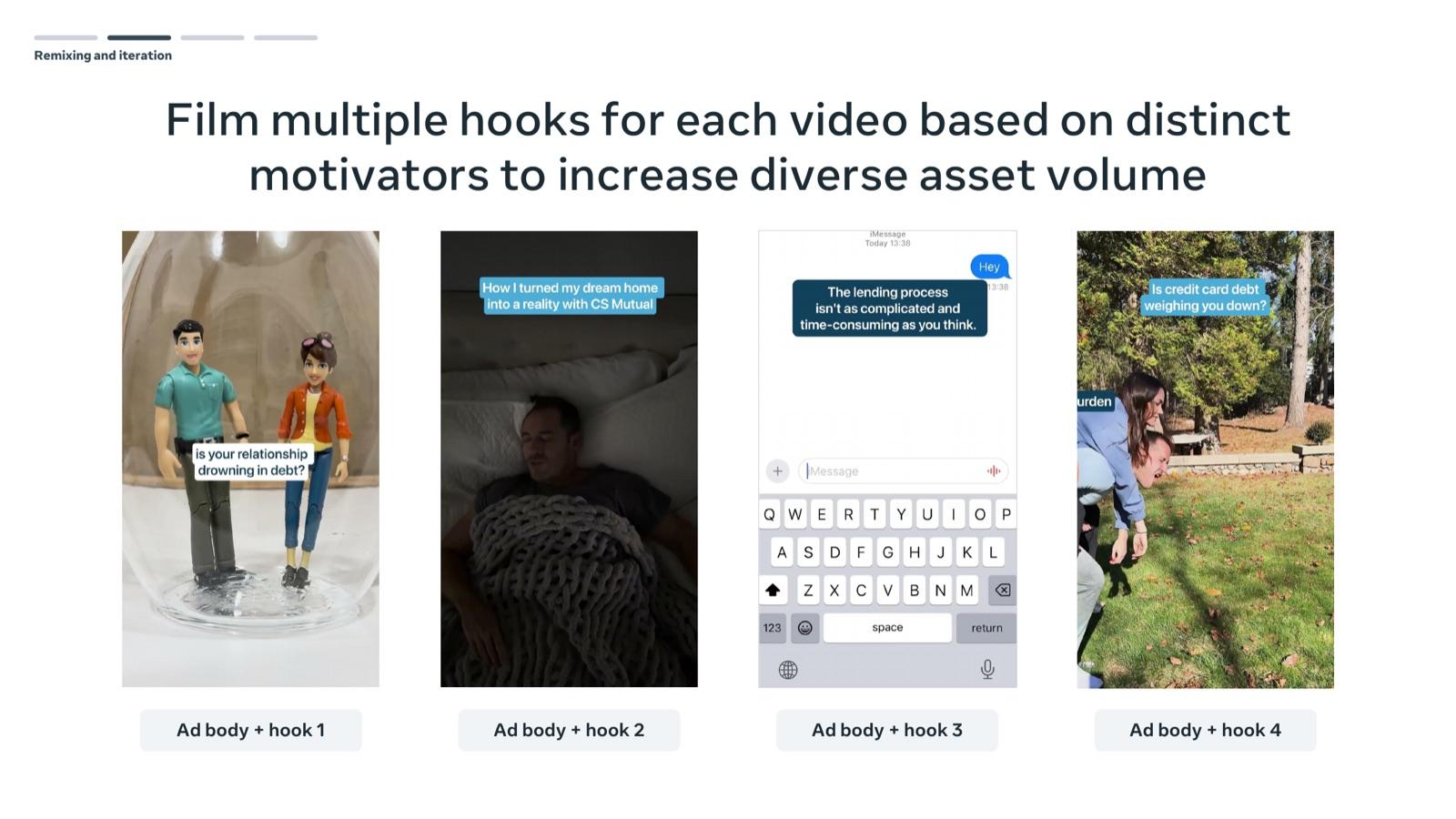
Film several hooks for each video
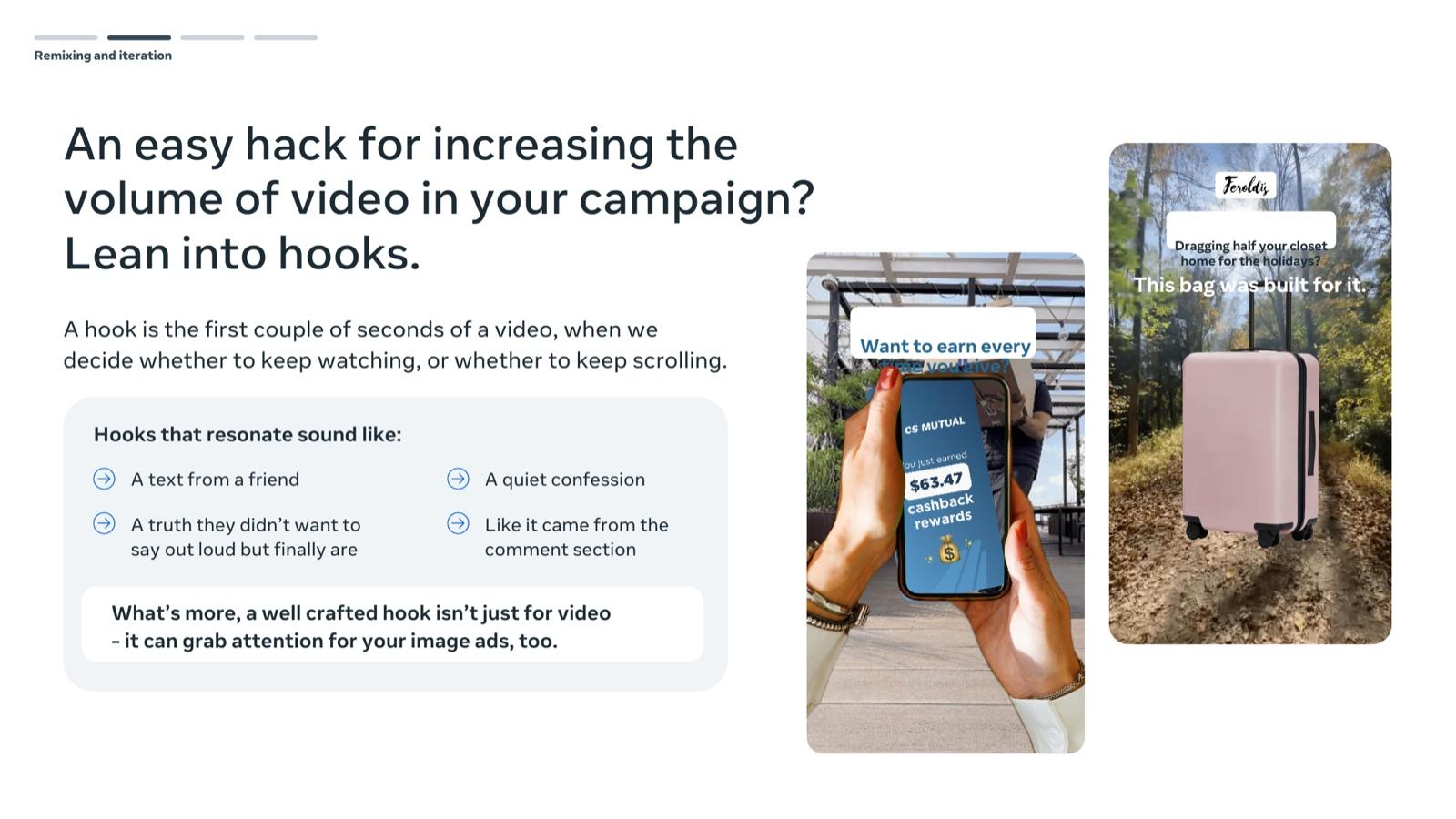
The hook is the first couple of seconds, when people decide to watch or scroll. Shoot one video body and four or five different openings, each built on a different motivator. Meta describes hooks that work as sounding like a text from a friend, a quiet confession, something people did not want to say out loud, or a line from the comment section.
Recut existing videos
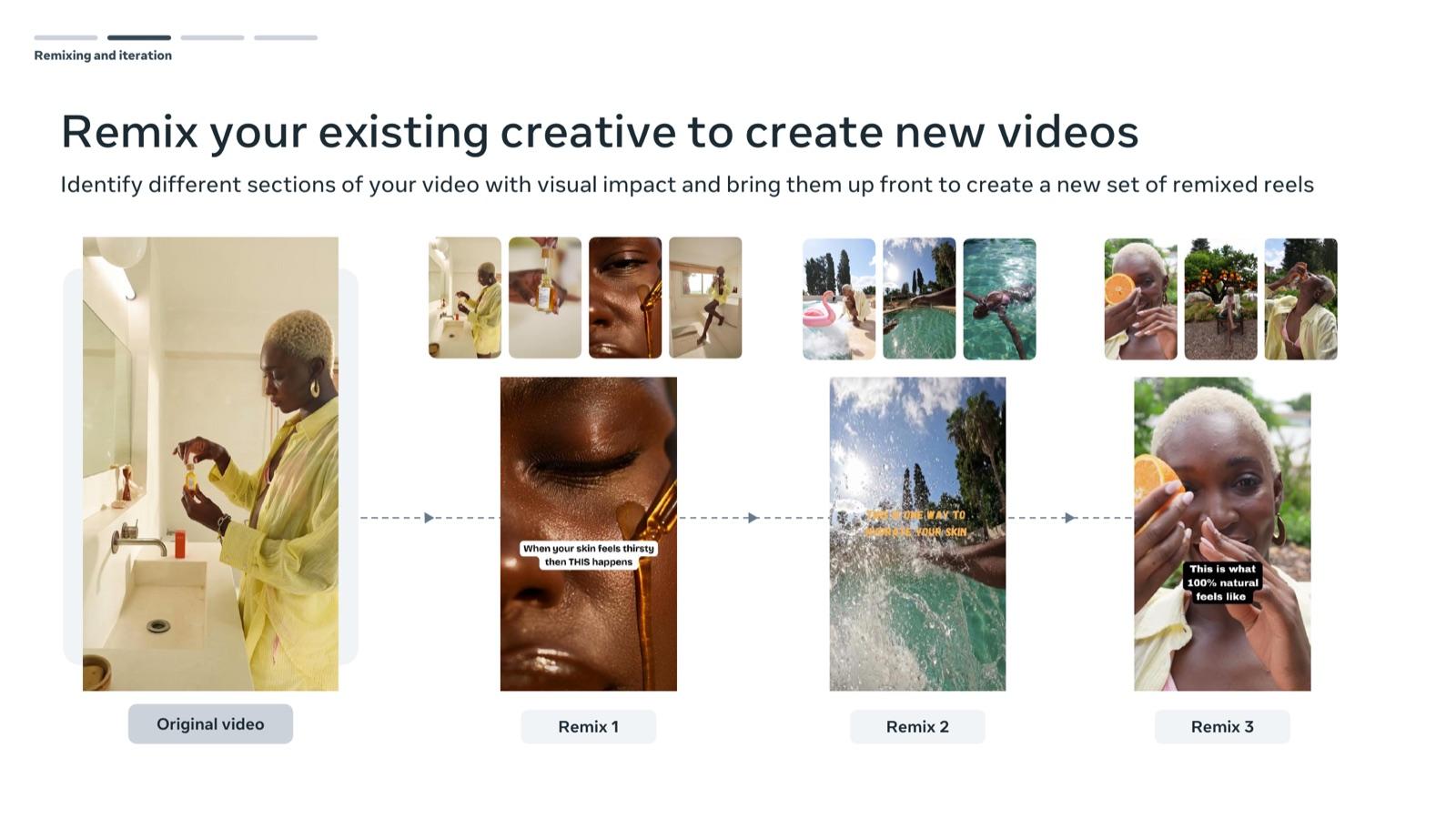
Find the strongest moments in a video and move them to the front. Each recut is a new reel that starts with a different idea.
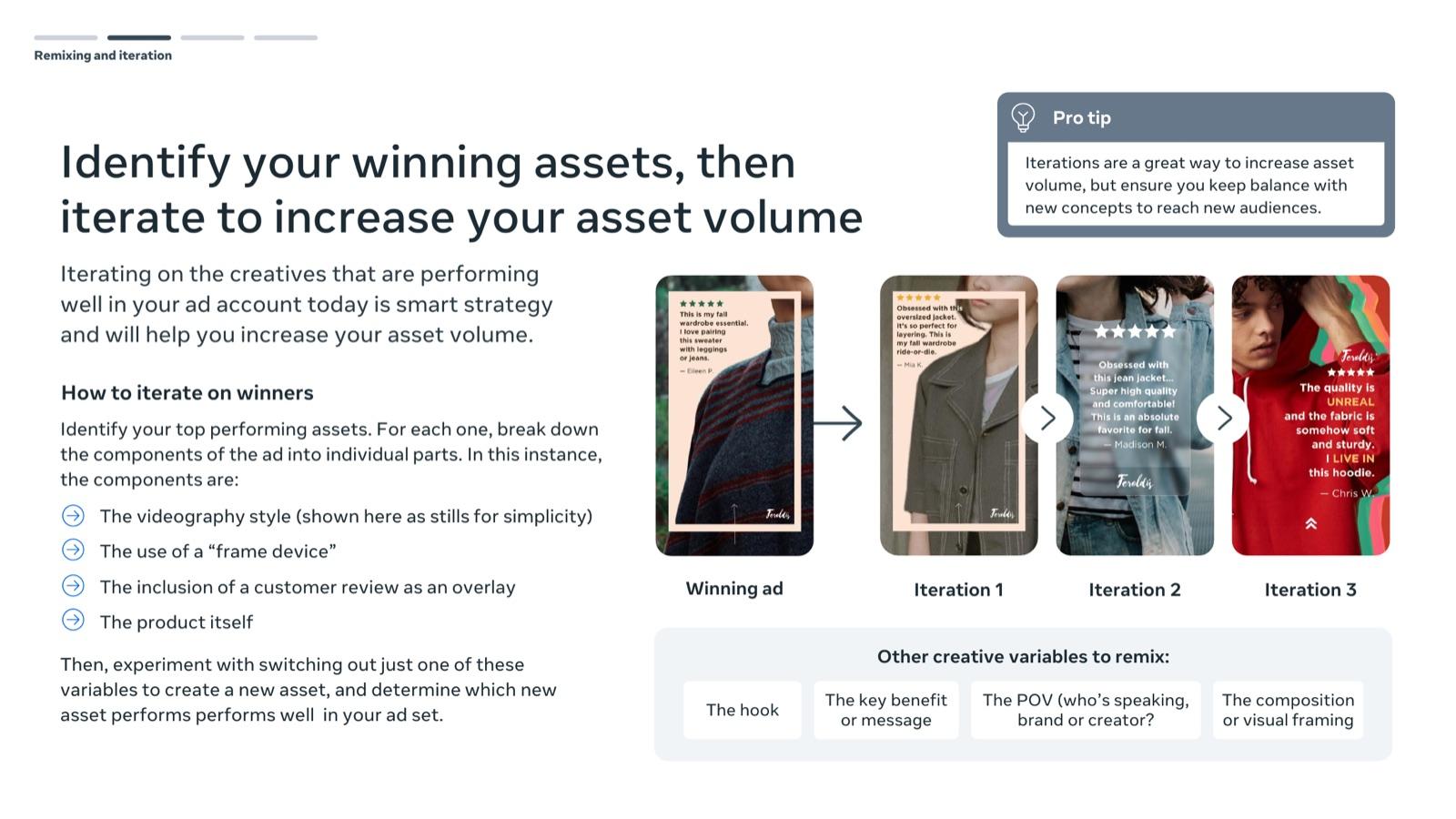
Change one part of a winning ad at a time
| Hook | Visual style | Frame device | Review overlay | Key benefit | Speaker | |
|---|---|---|---|---|---|---|
| Winning ad | ||||||
| Iteration 1 | ||||||
| Iteration 2 | ||||||
| Iteration 3 |
Orange: the one part that changed. Everything else stays as it was in the winner.
Pick your top performers
Choose the ads with the best results over the last 30 days.
Check it worked: You have three to five winners.
Break each one into parts
List its hook, visual style, framing device, overlays such as a review, key benefit, and who is speaking.
Check it worked: Each part is written down separately.
Change one part per new ad
Make new versions that swap exactly one part and keep the rest.
Check it worked: Each new ad differs from the winner in one way only.
Keep making new concepts too
Meta's caution: iterations raise volume, but new concepts are what reach new audiences.
Check it worked: At least one new concept ships alongside each round of iterations.
Section 6: turn one asset into three formats
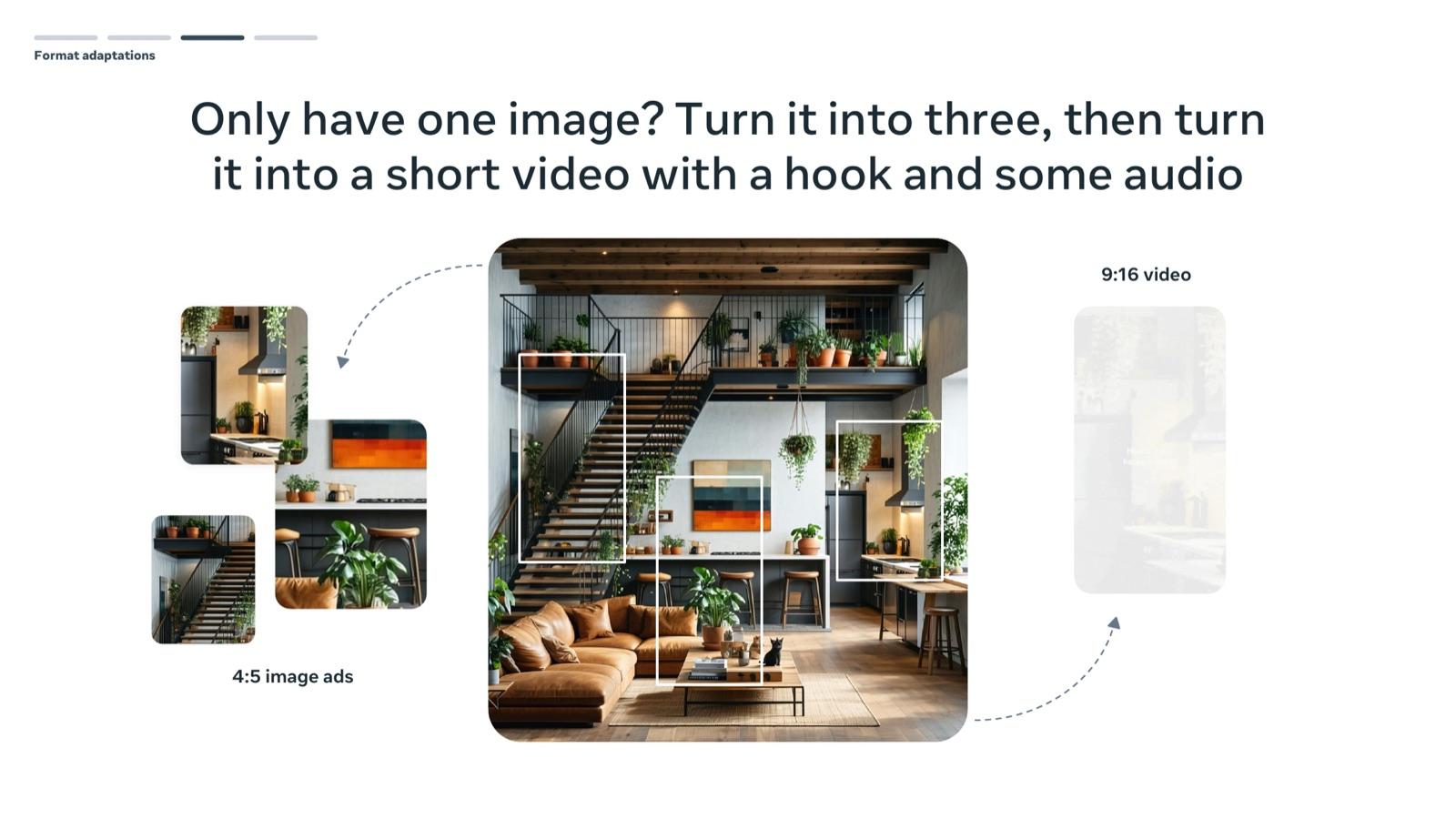
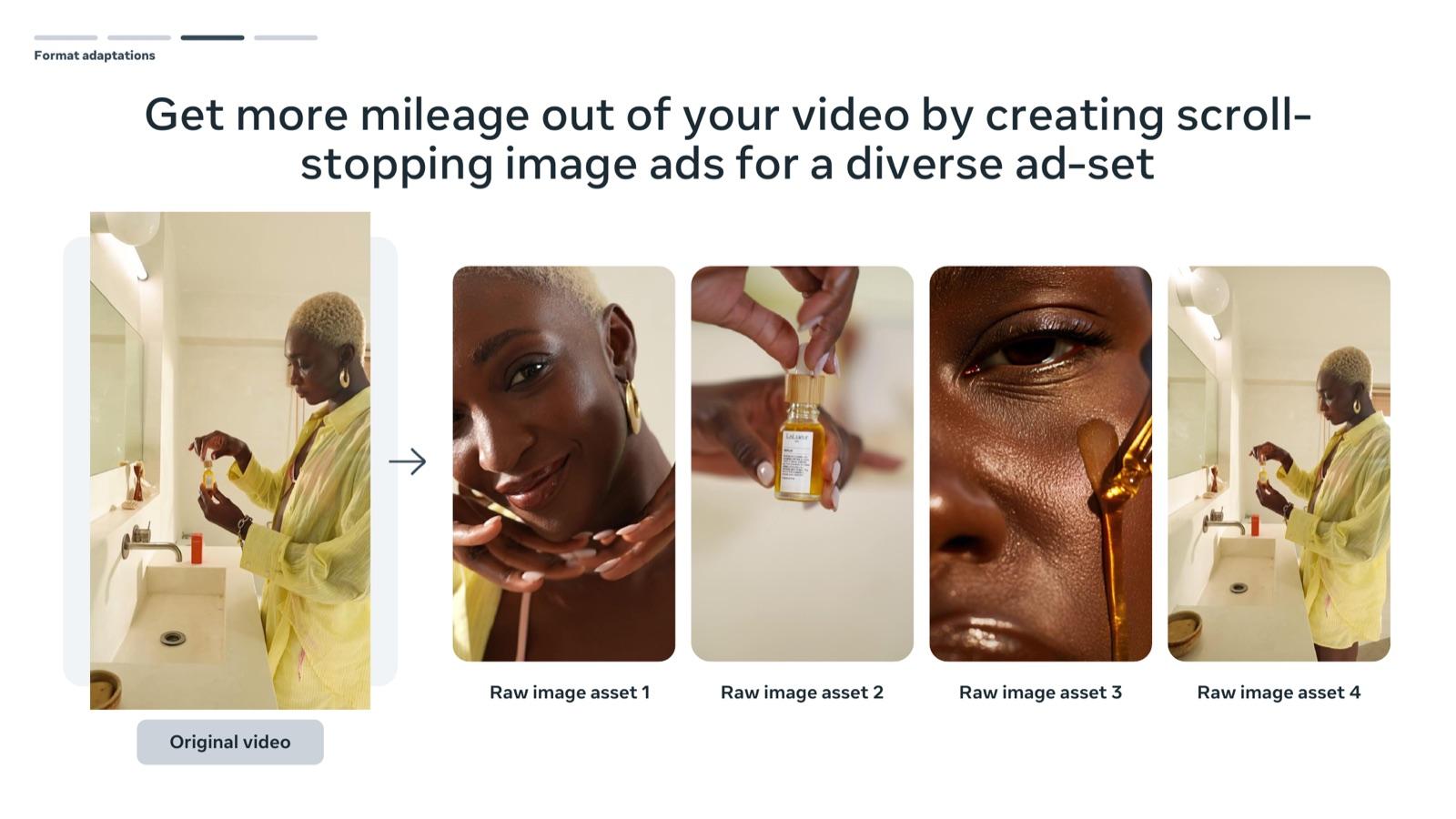
- Shoot 9:16 first. Then adapt the edit to 4:5 and pull the strongest frames as image ads. The same stills work as thumbnails.
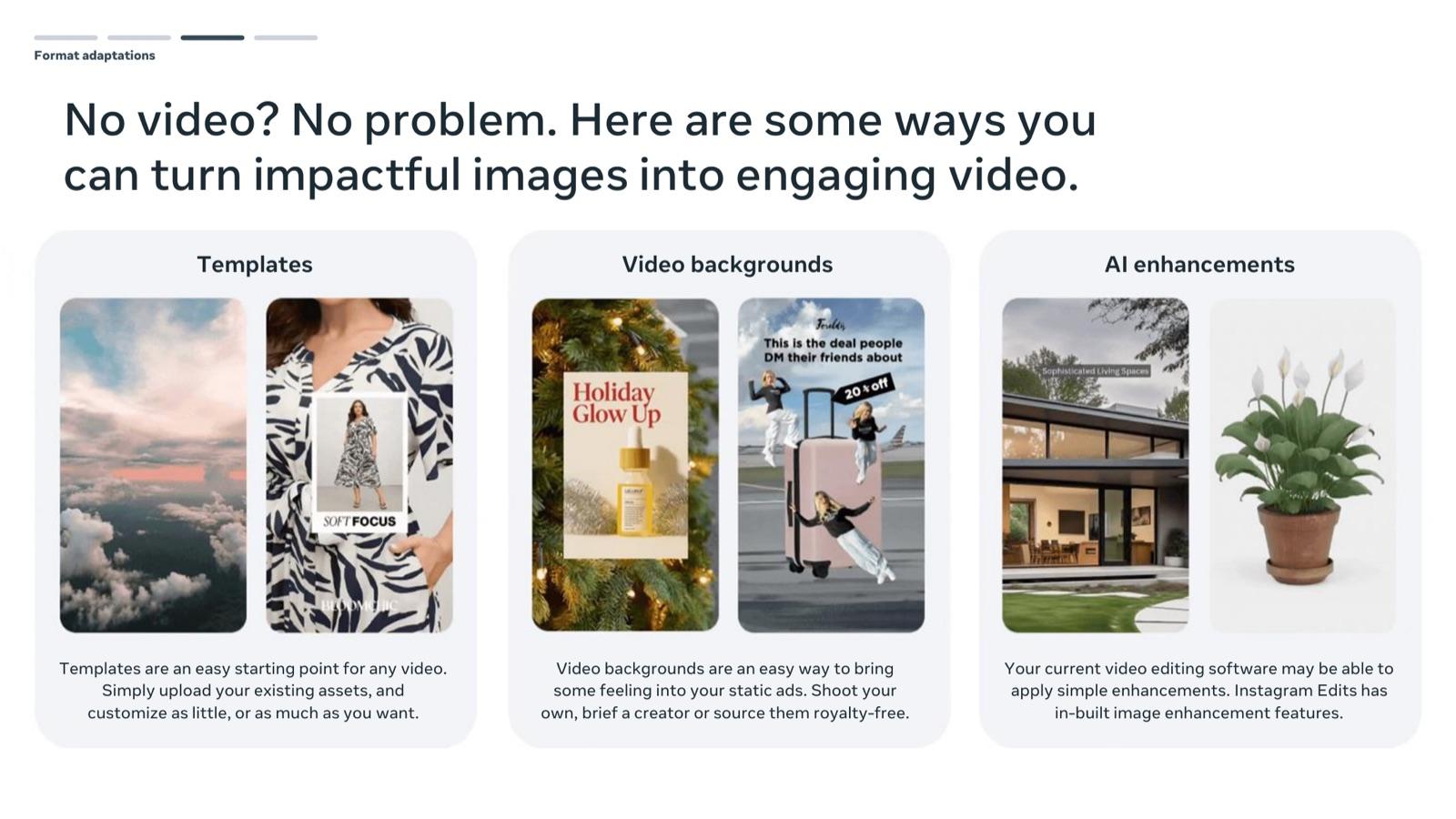
- No video? Use templates, video backgrounds behind a product image, or simple AI enhancements to turn an image into a short video.
- One image? Turn it into three variations, then a short video with a hook and audio.
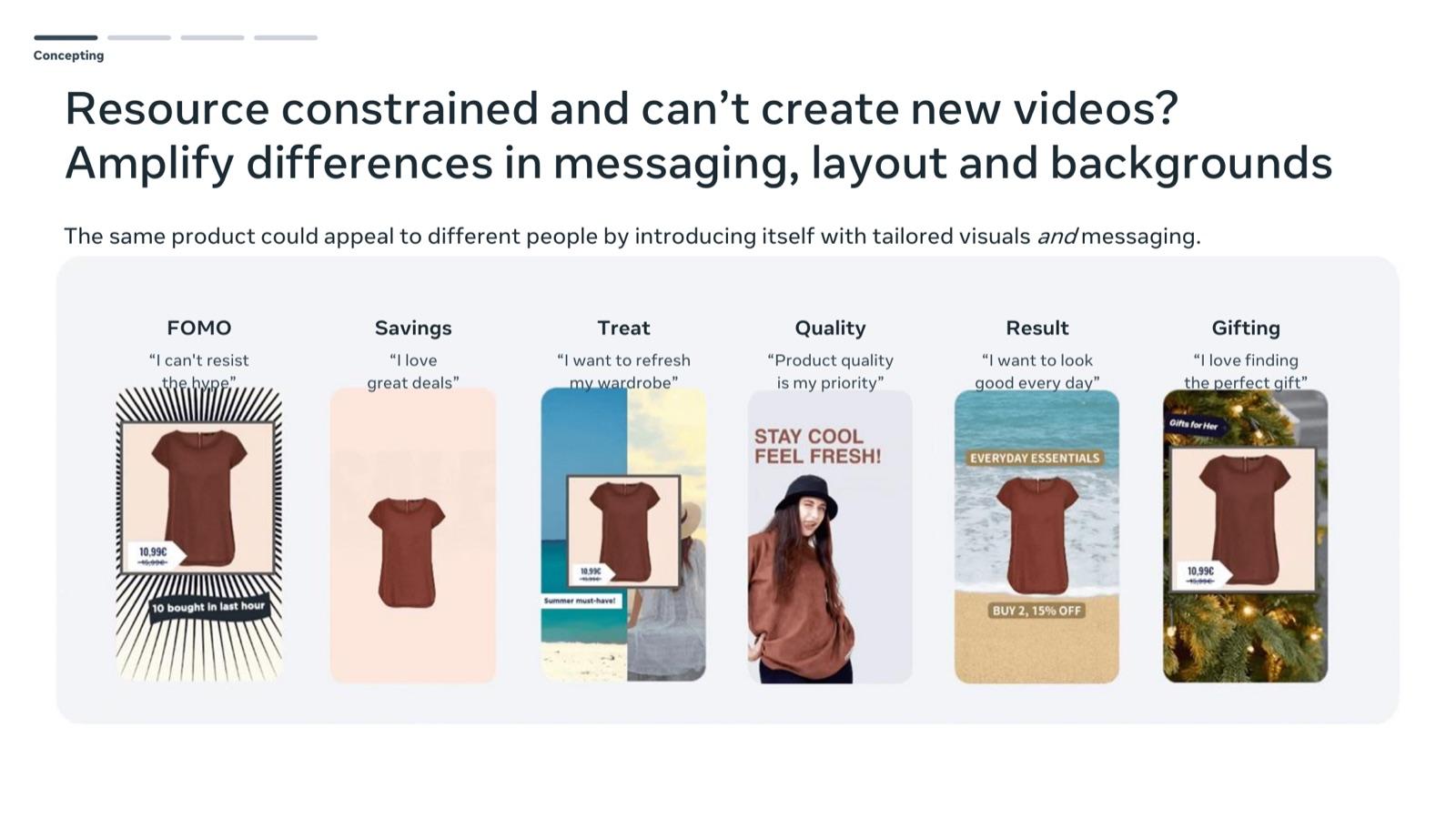
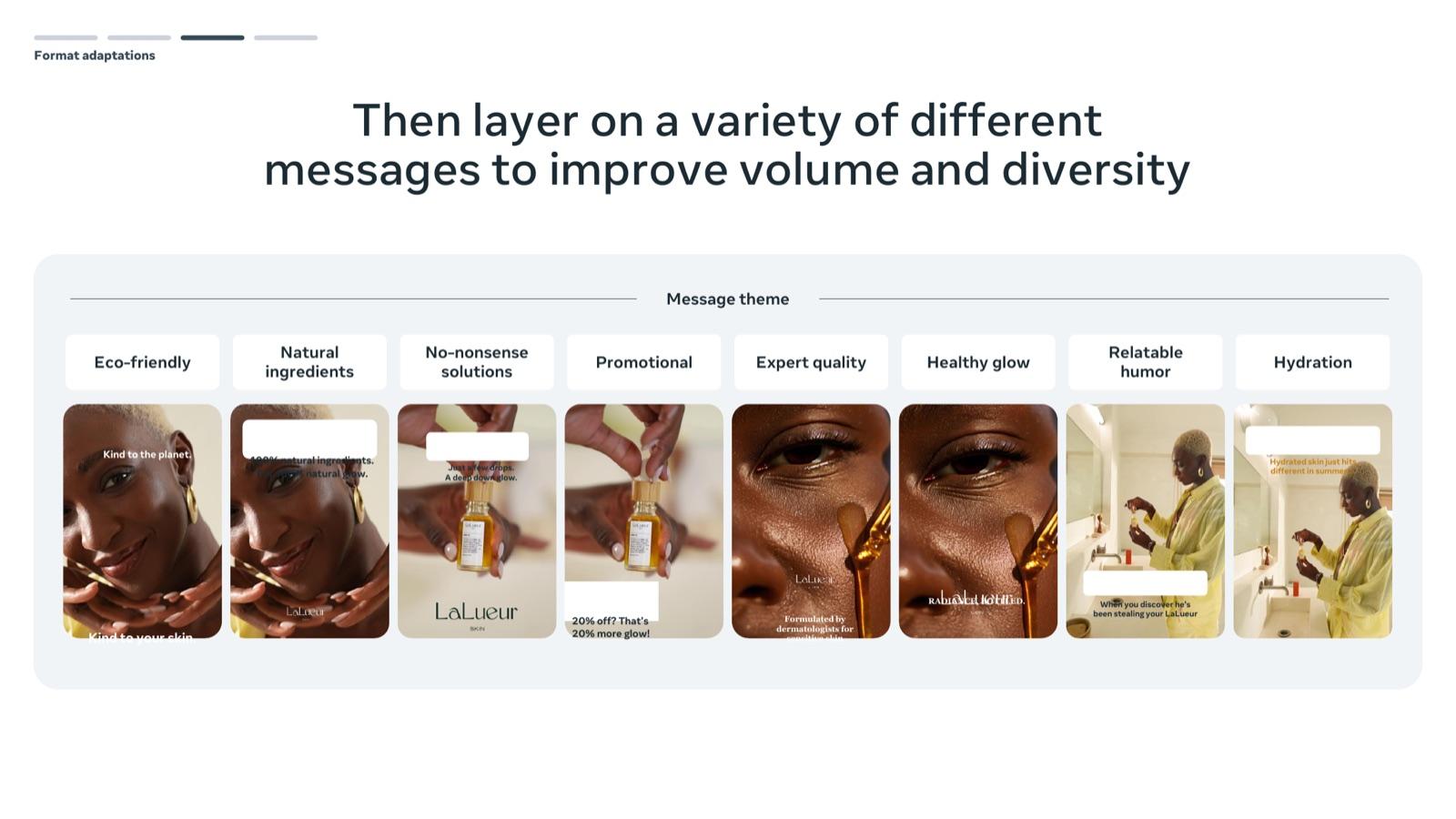
- Layer messages. The same visual with different overlays: a promotion, an expert claim, a result, a joke.
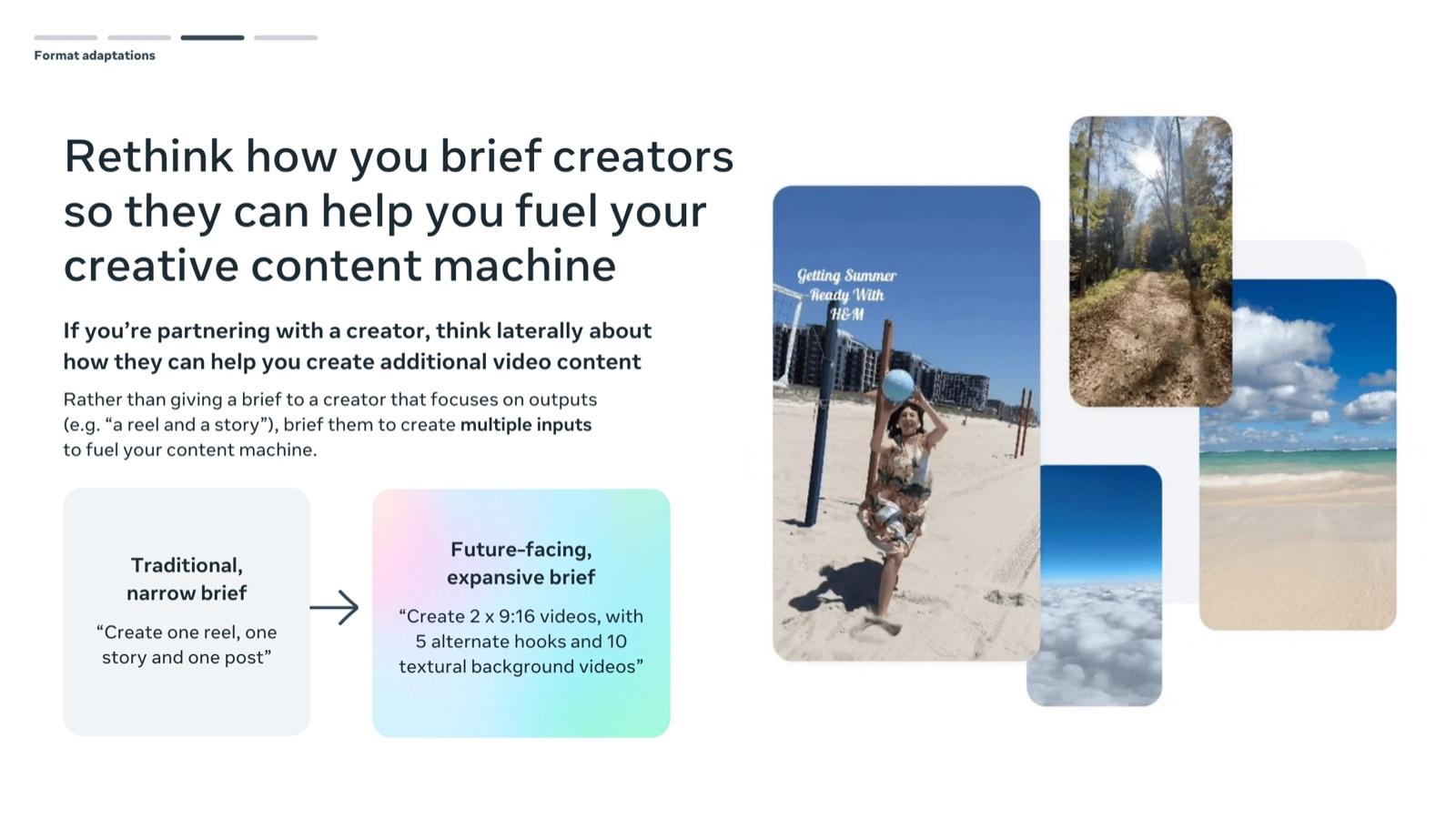
- Brief creators for inputs, not outputs. Instead of "one reel, one story, one post", ask for "two 9:16 videos, five alternate hooks and ten background clips".
- Add product videos to your catalog so catalog ads can use them.
Section 7: Advantage+ creative features
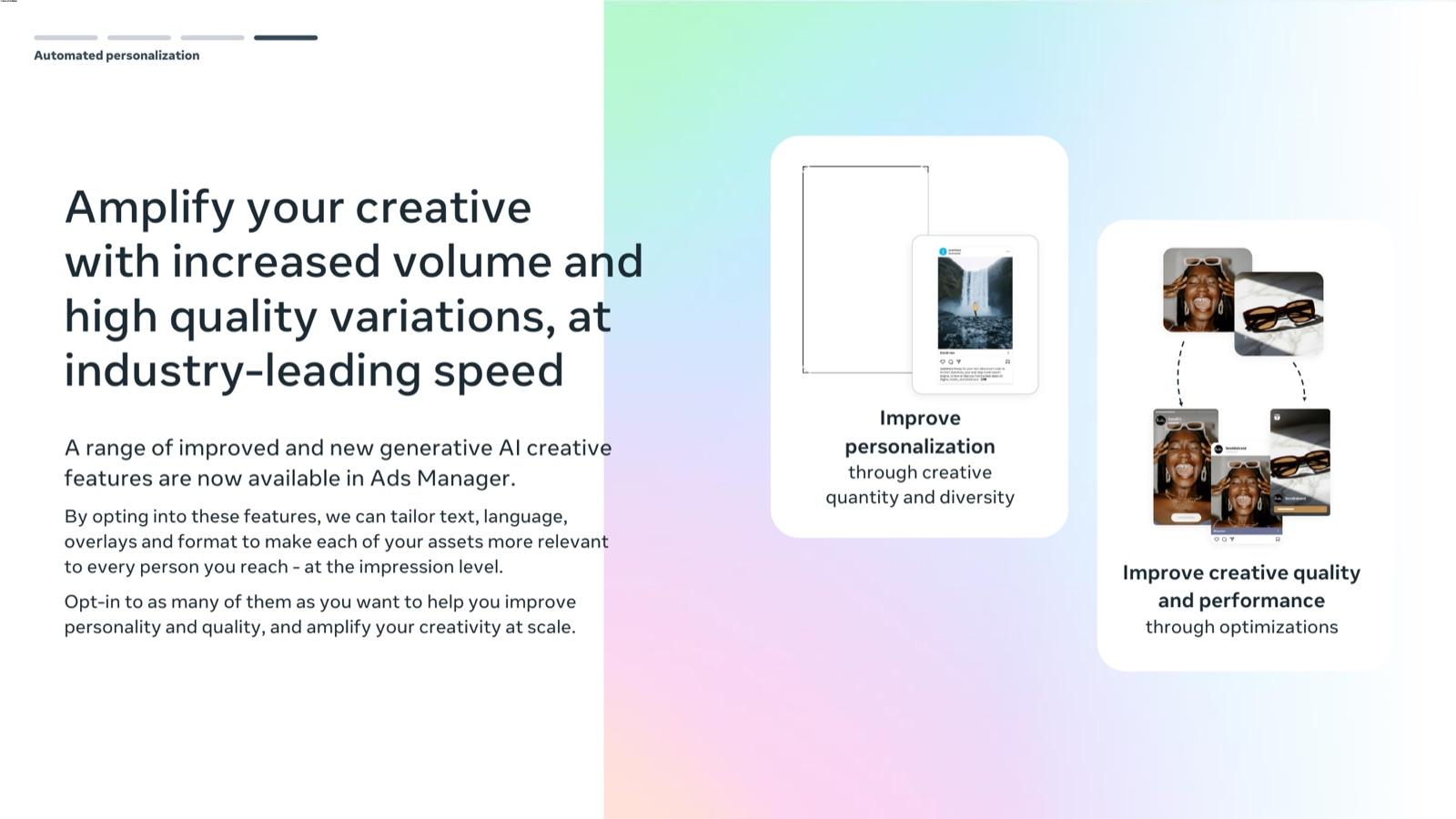
The last section lists the generative AI features in Ads Manager under Advantage+ creative. When you opt in, Meta can adjust text, language, overlays and format for each person at the moment the ad is shown. Some are in beta and not available in every account.
| Feature | What it does |
|---|---|
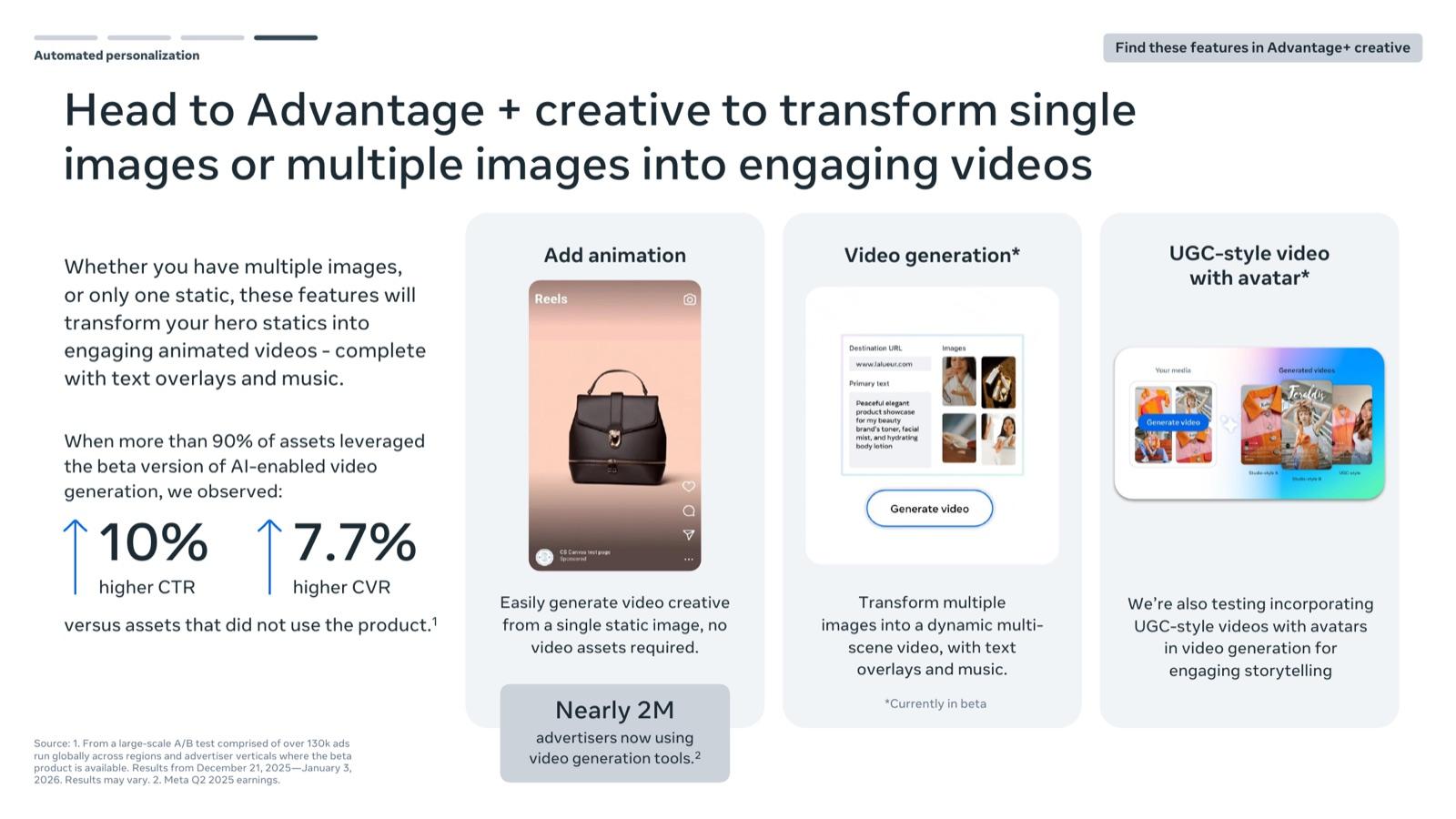
| Add animation, video generation (beta) | Makes a video from one or several still images, with overlays and music |
| UGC-style video with avatar (beta) | Being tested inside video generation |
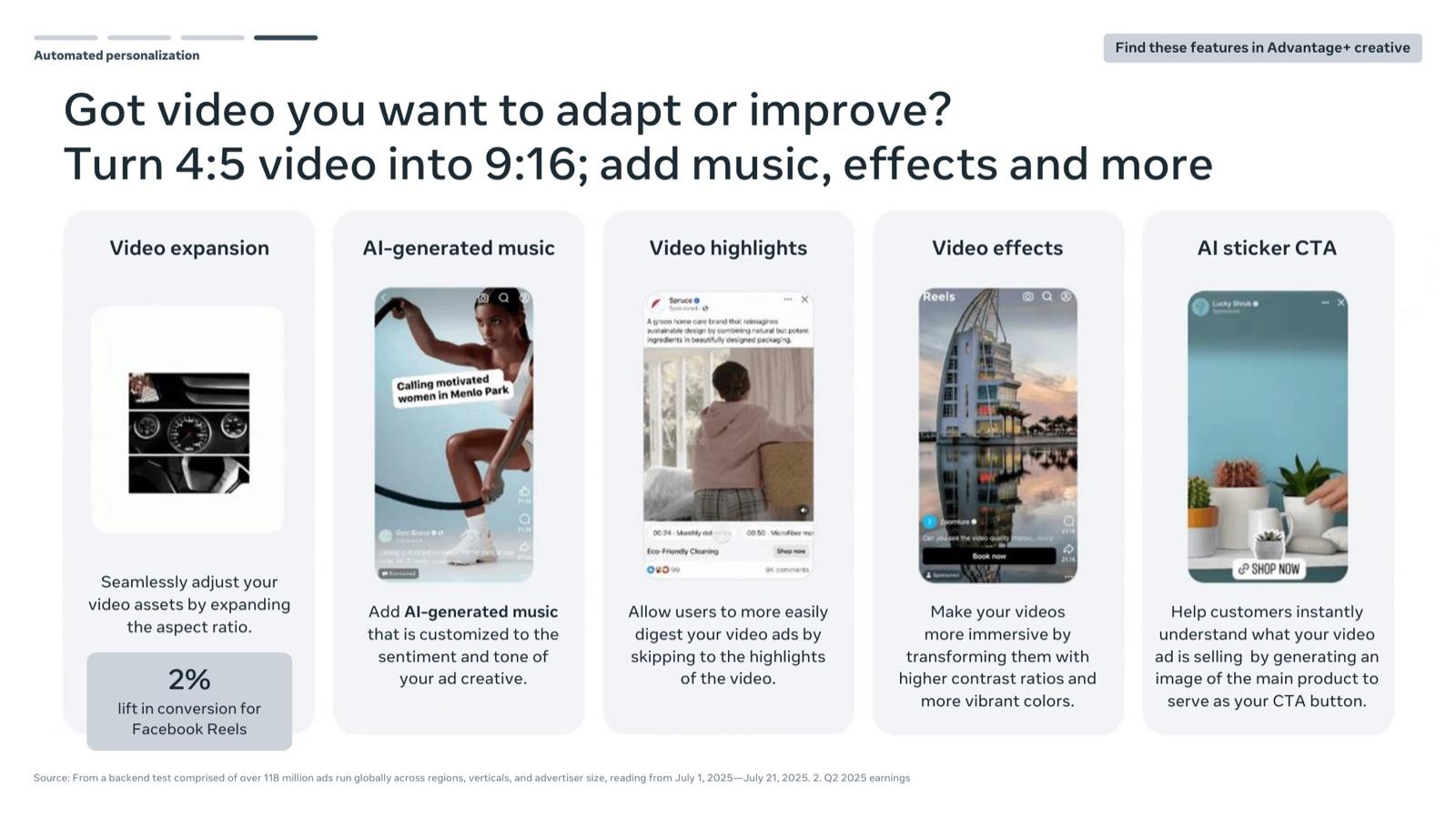
| Video expansion | Extends a 4:5 video to 9:16 |
| AI-generated music | Music matched to the tone of the ad |
| AI sticker CTA | Generates an image of the main product as the call-to-action button |
| Video highlights, video effects | Lets people skip to key moments; boosts contrast and colour |
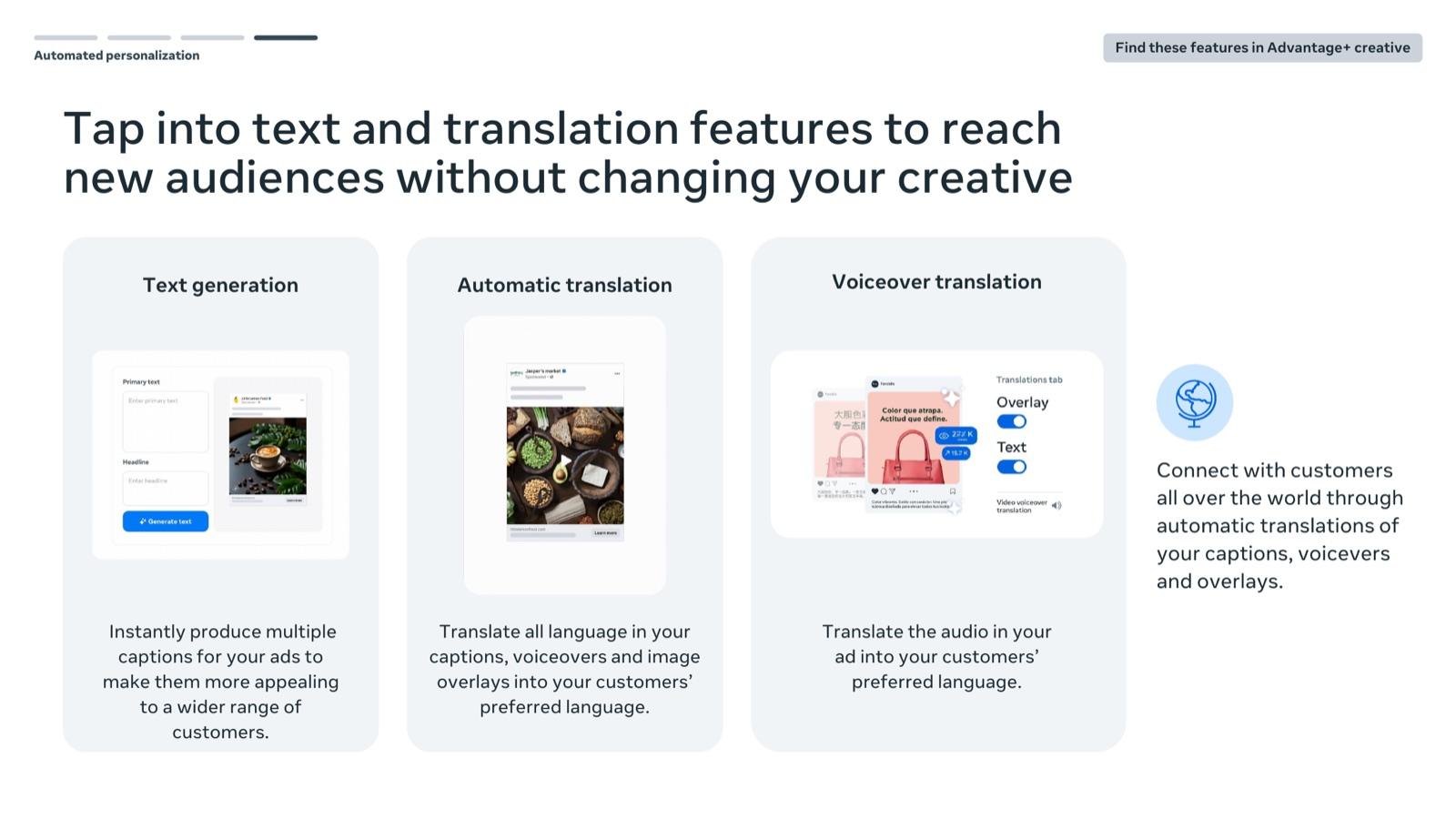
| Text generation, translation, voiceover translation | More caption variants; captions, overlays and audio in the viewer's language |
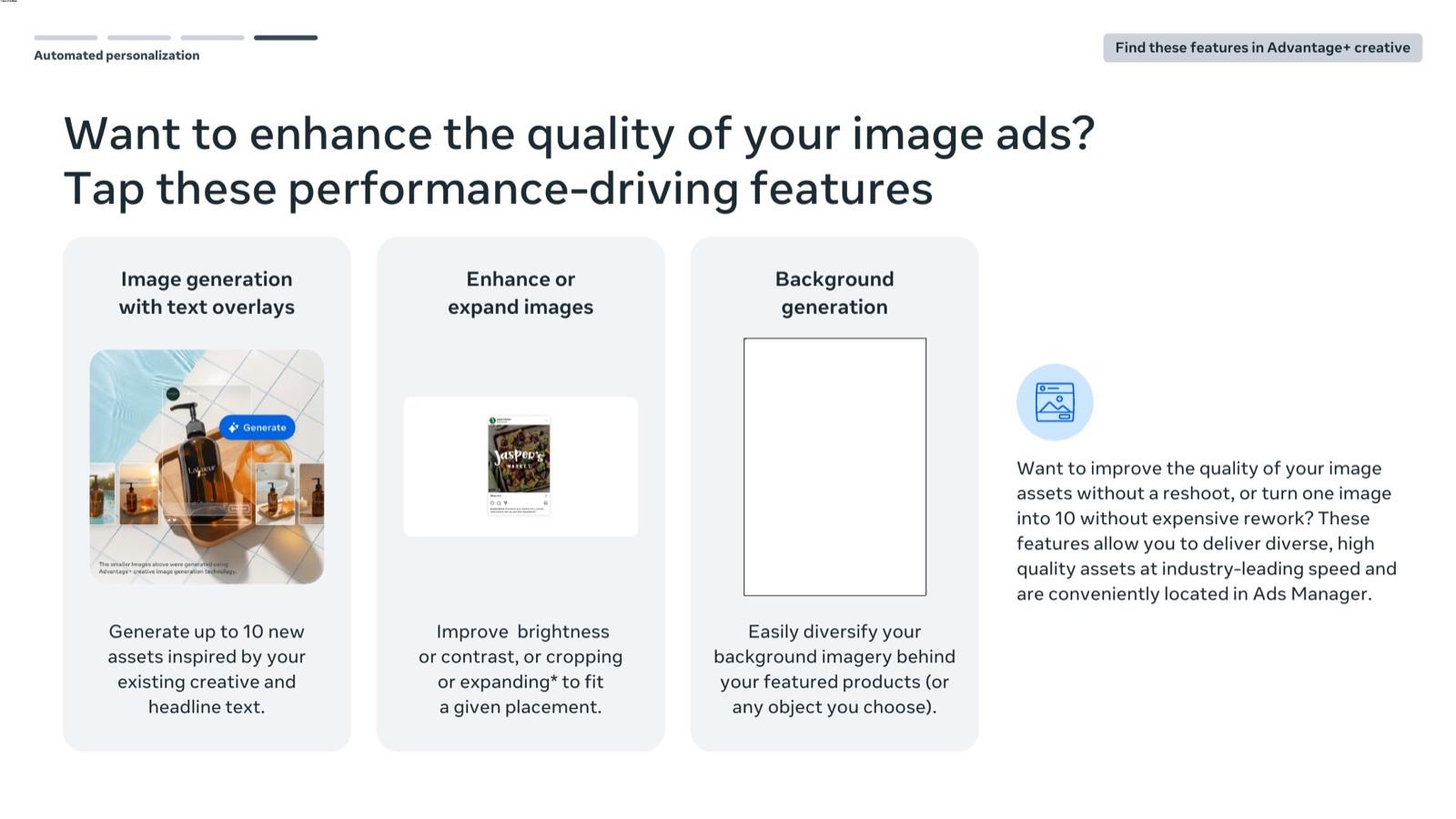
| Background generation, image generation with overlays, enhance or expand | New backgrounds, up to ten new images from one, brightness and cropping fixes |
Meta reports that in a large A/B test (December 21, 2025 to January 3, 2026), assets where more than 90% used beta video generation had 10% higher click-through rate and 7.7% higher conversion rate, and that the AI sticker CTA lifted conversions 2% on Facebook Reels.
What to do with this before Black Friday
By November 20
- Every sale ad set has a 9:16 video with audio, a 4:5 or 1:1 video, and a 4:5 or 1:1 image
- 9:16 video with audio is at least 20% of each ad set
- Advantage+ placements on, or six or more placements selected
- Three motivators written for the sale offer, each with its own concept
- Four to five hooks filmed or cut for your best sale video
- Each winning ad iterated on one part at a time, plus one new concept
- Product videos added to the catalog for your top sale products
- Advantage+ creative features reviewed for claims before opt-in
For how to set up the sale campaign itself and scale the ads that win, see the Black Friday playbook.
Questions people ask
- What is creative diversification on Meta?
- Meta's term for giving each ad set a mix of formats (video and image) and concepts (different visuals and messages), so its delivery system can match a better ad to each person and creative fatigue sets in more slowly.
- How many ads should an ad set have in 2026?
- Meta's playbook sets a minimum of three formats per ad set: a 9:16 video with audio, a 4:5 or 1:1 video, and a 4:5 or 1:1 image, with 9:16 video making up at least 20% of the set.
- What are motivators in Meta's creative playbook?
- The reasons people buy, such as wanting proof a product works or needing a gift fast, along with the barriers that make them hesitate. Meta recommends building each concept from one motivator instead of from demographics.
- How do I scale a winning ad on Meta?
- Break it into parts (hook, visual style, framing, benefit, speaker) and make new versions that change one part at a time, while still adding new concepts to reach new audiences.
Sources
Corrections: if a platform detail on this page is out of date, tell us at support@zappush.com and we will fix it and update the date above.
Not affiliated with Meta. The slides are from Meta's Creative Playbook 2026, shared for educational purposes; Meta and its marks belong to Meta Platforms, Inc.
How Zappush does this
Attribution →
Go deeper
How to scale during Black Friday →