Skip to content

Unrestrict your
Health & Wellness brand.

Zappush makes restricted-category tracking compliant. We remove health-sensitive context before it reaches Meta, preserve the conversion signals its algorithm needs, and deliver them server-side through the Conversions API.

Trusted by brands across

Weight LossSupplementsCosmetic & Med SpaCBD & CannabisSkincare & Anti-AgingSexual & Reproductive HealthMental Health & SleepPain Relief & Recovery

Selling in a restricted category?

Meta classifies your domain automatically. Your ads stay approved. Your conversion events get silently blocked.

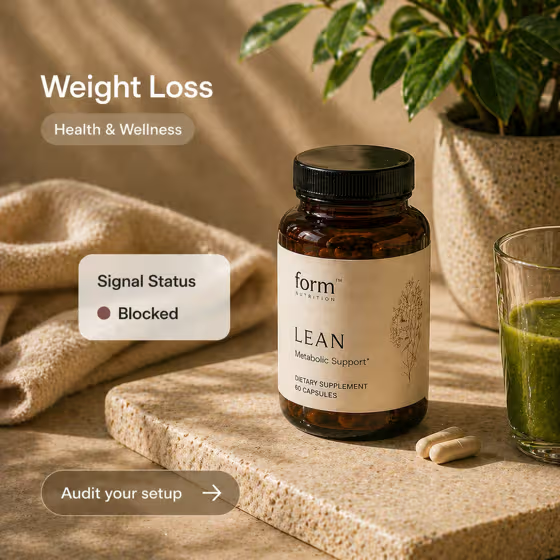
Weight Loss

Health & Wellness

Weight loss implies obesity. Obesity is a disease.

Weight tracking appsMeal replacement deliveryGLP-1 drugWeight loss coachingDiet programsFat burner productsAppetite suppressants
Weight loss category restricted by Meta

If you’re selling weight loss products like meal replacements, fat burners, GLP-1 supplements, or coaching programs, anyone buying your product implies they have obesity. To Meta, that’s a medical condition.

When a Purchase or Lead event includes customer identifiers alongside condition-specific product context, it may reveal or imply sensitive health information that Meta prohibits businesses from sending through its Business Tools.

So Meta places data sharing restrictions on your domain under the Health & Wellness category. Your ads keep running. Your pixel keeps firing. But your conversion data is blocked or degraded, and Meta’s optimization algorithm loses signal. Your campaigns go blind.

Audit your website

Flagged domains. Blocked events. Rising costs.

Category restrictions can damage the same system in three places: Meta classifies the domain, limits lower-funnel events, and makes impressions and acquisitions more expensive.

Flagged Websites

Meta categorizes your domain based on the products and services you sell, which can lead to category restrictions.

Manage data source categories

DomainsSourceCategoryform.comWebsiteH&W - Othermedspa.comWebsiteH&W Providerhempcbd.comWebsiteH&W Condition

Restricted Pixel

Your pixel fires, but Meta silently blocks key events such as Purchase, AddToCart, and Lead. With less lower-funnel feedback, optimization weakens and acquisition costs can rise.

Initiate checkout

Active

850

Add payment info

Active

454

Purchase

Active

346

Your event is blocked

Your event is blocked because of how your data sources are categorized.

CPM and CPA Spike

In an illustrative restricted-account example, lower-funnel signal loss coincided with CPM moving from $15 to $60, while CPA rises alongside it.

Before restriction

$15 CPM

After restriction

$60 CPM

Before$15
After$60
CPM increase
Acquisition costCPA rises too

Illustrative account example. Results vary.

Meta's AI is only as good as the data it gets.

When a data source is restricted, events such as Purchase, AddToCart, and Lead can be blocked or stripped. Meta receives less dependable conversion feedback, weakening matching, learning, and lower-funnel optimization.

Audit your website

Unrestrict your Meta category in three steps.

Remove what triggers restrictions. Preserve what Meta needs to optimize. Restore compliant lower-funnel delivery without changing what you sell.

Route events through the Zappush compliant container

Zappush routes each event through a compliant container that applies Meta-specific rules before delivery, so your data source and Pixel remain unrestricted.

Your Store
Meta Ad Account

Delivered via the Conversions API with controlled server-side delivery.

The recovered signal goes back to work.

Once clean events reach Meta, campaigns have better data to learn from. That can make performance steadier and reduce wasted spend.

Meta receives your key conversion events

AddToCart, InitiateCheckout, Purchase, and Lead reach your ad account, so campaigns can optimize for the actions that matter most to your business.

Campaign performance becomes more stable

Meta learns from consistent conversion data instead of incomplete signals, making delivery and attribution less erratic.

CPM and CPA can come down

Reach more people at a lower cost with complete conversion signals, lower CPM, and lower CPA.

Send offline conversions from your CRM or POS

Connect HubSpot, Salesforce, Zoho, or your clinic’s CRM or POS. When a lead books, attends a consultation, or becomes a customer, Zappush sends that stage back to Meta and Google automatically.

Four common fixes. The category restriction remains.

Custom events, CAPI alone, appeals, and subdomains may change the setup—but none removes Meta’s domain classification or restores blocked lower-funnel events on its own.

No, renaming your events to custom events doesn't fix the restriction.

Changing an event name does not make prohibited underlying data permissible. An event called "event_01" can still be restricted when its URL, product metadata, or customer context reveals sensitive health information.

Zappush view

Event Payload

Name changed. Payload unchanged.

Renamed
event_name"event_01"
content_name"GLP-1 Kit"
category"Weight Loss"
Blocked by Meta

Payload evaluated, not event name

Server-side Infrastructure · Delivered via Conversions API

Full-funnel visibility from ad click to purchase.

Every event, every shopper, every dollar — tracked end-to-end in one dashboard. Delivered server-side via Meta's Conversions API.

Meta CAPI Delivery

98.7%

Server-side delivery rate

Event Match Quality

8.2

/ 10

Every event delivered server-side via Meta's Conversions API. Failed deliveries retry automatically. Average EMQ of 8.2 — well above the 6.0 threshold for optimal ad performance.

app.zappush.com

Events Sent

12,847

+14%

Delivered

12,680

98.7%

EMQ Score

8.2

Above threshold

Failed

42

0.3%

Retried

125

100%

CAPI Event Delivery

PageView
4,821Delivered
ViewContent
3,214Delivered
AddToCart
891Delivered
InitiateCheckout
384Delivered
Purchase
247Delivered

Not sure if you’re restricted?

Free tool that simulates Meta’s classification engine on your landing page. No signup required.

Audit your website

Brands that refused to stay restricted.

Health & wellness brands trust Zappush to deliver permitted conversion data, improve signal reliability, and support more stable Meta performance.

75+

Brands supported

Restricted-category businesses reviewed or supported by the Zappush team.

98.7%

Event delivery rate

Server-side events confirmed received by Meta. Failed deliveries are automatically retried.

Days–2 weeks

Typical deployment window

Timing varies with the landing experience, domain, Pixel history, consent setup, and existing infrastructure.

$2.4M+

Ad spend protected

Ad spend that would have been lost to account restrictions, now flowing through compliant infrastructure.

Based on internal Zappush implementation data. Results vary by account history, spend, event volume, and deployment scope.

GLP-1

Selling GLP-1 puts every word on our website under Meta’s microscope. Which means putting us in a restricted category. And then fragmented data and wasted spend were killing us until Zappush rebuilt our server-side tagging end-to-end. The pipeline scales with us, fully within Meta’s Health & Wellness policy: no pixel violations, no account warnings, just clean signal feeding our campaigns. In a category this scrutinized, that’s the difference between scaling and stalling.

Scaling, not stalling, in a sensitive category

Jared

Founder, GetLean

Body Transformation & Med Spa

We’re a New York laser and aesthetics clinic, squarely inside Meta’s most restricted ad category. Before Zappush, our pixel data was unreliable and CAPI events were getting rejected without explanation. They audited everything and rebuilt our server-side infrastructure to be fully Meta-compliant. Lead quality improved, attribution finally matched our CRM, and we stopped losing sleep over policy strikes.

Lead quality up, CRM-matched attribution restored

Pat S

Founder & CEO, Perfect Body NY

Health Tech

Respyr is a consumer device that screens for serious health markers: blood sugar, liver function, respiratory issues, gut health. Building a policy-compliant data pipeline was non-negotiable. Zappush understood the nuance immediately. They shipped a server-side setup that captures the signal we need for performance marketing without tripping a single Health & Wellness classifier.

Zero Health & Wellness classifier triggers

Ankur

Founder, Respyr

Book a consultation75+ brands supported

No commitment. See how Zappush works for your brand.

Ready to protect
your ad account?

Book a free 30-minute call with our team. We’ll review your current Meta advertising setup and show you exactly how Zappush would work for your store.

Custom pricing based on your store. 30-day money-back guarantee.

No commitment

FAQs

Forty answers to the questions restricted brands ask us most.

Restrictions & policy

What is Meta's Health and Wellness ad restriction?

Meta classifies domains that sell health-adjacent products under Health & Wellness, then restricts what conversion data those domains can share back through the pixel and CAPI. Ads keep running. The data feeding Meta's optimization stops.

Why is my Meta pixel restricted?

Meta's classifier flagged your domain. From that point Purchase, AddToCart, and Lead events are filtered or suppressed depending on the restriction level. Notifications go to the Business Manager email, not the ad account, so most brands discover it weeks after the fact.

What does "data sharing restrictions applied" mean in Events Manager?

Meta has classified your domain under a restricted category. Depending on severity your events are filtered (Level 1), partially blocked (Level 2), or fully suppressed (Level 3). Check Data Sources, then Categories to see your level.

What are the three levels of Meta Health & Wellness restrictions?

Level 1 (Core Setup) strips metadata but events still fire. Level 2 (Standard Event Restrictions) blocks Purchase, AddToCart, and Lead. Level 3 (Full Domain Restriction) blocks everything from the domain. Each level needs a different fix.

Are CBD or THC products restricted on Meta?

Yes. THC is prohibited from sale entirely. CBD is restricted to 18+ and cannot make health claims. Brands selling CBD with condition-adjacent positioning get classified under Health & Wellness on top of the CBD restriction.

Are GLP-1 and weight loss products restricted on Meta?

Yes. GLP-1, semaglutide, and any quantified weight-loss product or claim is treated as health-adjacent. Even compliant supplement brands get classified when their positioning suggests body-change outcomes.

Are botox, med spa, or aesthetic treatments restricted on Meta?

Yes. Cosmetic procedures fall under Meta's restricted categories. Before-and-after photos are explicitly prohibited and the classification compounds with provider-relationship signals like booking flows or consultation copy.

Are sexual wellness or testosterone products restricted on Meta?

Yes. Meta restricts non-surgical genital enhancement, ED treatment, libido supplements, and testosterone boosters under both Health & Wellness and Adult Sexual Products policies.

Are supplements with health claims restricted on Meta?

Yes when claims tie to a condition: blood sugar, sleep, hormones, cognitive function. Generic vitamin SKUs without condition-adjacent positioning often escape classification.

Does this only apply to health and wellness brands?

No. Meta's classifier is inferential, not keyword-based. Brands selling ergonomic pillows, fitness apparel, breast pumps for lactating mothers, immigration-law services flagged under "nationality," and supplement brands without overt health claims have all been classified. If buying your product implies the buyer has a health condition, life situation, or protected attribute, you are at risk regardless of whether you use clinical language.

Creative & imagery

Are before-and-after weight loss photos restricted on Meta?

Yes. Meta explicitly prohibits before-and-after body-change comparison in the context of weight loss and any imagery that implies negative self-perception. Transformation photos common in fitness marketing trigger restriction immediately.

Why does Meta prohibit before and after images?

The personal-attributes policy filters anything that could make a viewer feel bad about their body, age, weight, skin, or appearance. Before-and-after framing is the canonical example.

Are before-and-after images allowed for cosmetic procedures?

No. Cosmetic surgery, injectables, body contouring, skin whitening, and laser treatments cannot use before-and-after framing. Even non-clinical "transformation" results trigger the same filter.

Can I use customer transformation photos in Meta ads?

Not as before/after framing. You can use customer testimonials in writing or video that describe feelings ("more energy", "less bloated") without showing body changes.

What ad creative works for health and wellness without getting flagged?

Avoid direct health claims and transformation imagery. Show product, ingredients, and lifestyle context. Frame copy around the desire ("Ready for a change?") rather than the outcome ("Lose 14 lbs").

Are before-and-after images banned for body image content?

Yes. Any body-change comparison, including weight, fitness, posture, or skin appearance, falls under personal-attributes and is rejected.

What body-change imagery is allowed on Meta ads?

Lifestyle photography that does not compare two states is allowed. A single image of a person feeling good in their body, doing an activity, is fine. The comparison is what triggers the policy.

Are before and after images allowed in Google Ads or TikTok?

Google and TikTok enforce similar but not identical policies. TikTok's weight-loss policy is stricter on transformation framing. Google flags health/medical before-and-after with platform-specific exemptions for licensed clinical advertisers.

Why are my Meta ads getting rejected for personal attributes?

The personal-attributes filter catches creative that implies the viewer has a flaw (weight, skin, age, hair) and that the product fixes it. Reframe the hook around what the customer wants, not what they want to fix.

What replaces before-and-after photos in compliant Meta creative?

Customer voiceover testimonials, ingredient stories, lifestyle imagery without comparison, ASMR-style product shots, and benefit copy that does not reference outcomes. Most compliant DTC brands moved to UGC-style talking heads.

Pixel, CAPI & tracking

What's the difference between Meta Pixel and CAPI?

Pixel is a browser-side script that sends events from the user's browser. CAPI (Conversions API) is a server-side endpoint that sends events from your server. They are different delivery methods for the same Meta event system.

Does CAPI alone bypass Meta's restrictions?

No. Website events sent through CAPI remain subject to Meta's Business Tools terms, privacy controls, and data-sharing restrictions. CAPI improves connectivity; it is not a policy bypass.

Can you optimize campaigns for profit (POAS) or new-customer purchases instead of standard Purchase?

Where Meta permits the event and the underlying data, Zappush can map outcomes such as profit value, new-customer purchases, and AOV tiers into a server-side event strategy. We confirm the permitted fields and optimization options during the audit.

What is Meta's Conversions API and how does it work?

CAPI is Meta's server-to-server event endpoint. You send events from your backend with hashed user data and event metadata. Meta deduplicates against pixel events using event_id. It bypasses ad blockers and iOS ITP, not domain restrictions.

Can I run multiple business managers or pixels through one Zappush setup?

Zappush can support multiple authorized datasets or Pixels when the business has a legitimate operational need. We review ownership, consent, destination, and event-routing requirements before recommending the architecture.

Do we need a new pixel?

Not always. We first audit the existing Pixel or dataset, domain classification, event status, and permitted data. A new Pixel does not remove a policy restriction by itself, so we only recommend one when the implementation and account history justify it.

Can server-side tracking restore conversion events?

Server-side tracking can improve reliable delivery of permitted events when it is paired with consent controls, payload cleansing, accurate event mapping, and a compliant destination. Server-side delivery alone does not remove a policy restriction.

What is Event Match Quality and why does it drop?

EMQ is Meta's diagnostic for how effectively permitted customer information matches events to Meta accounts. It can fall when identifiers are missing, malformed, duplicated, or restricted. Improvement depends on consent, implementation quality, event volume, and the fields Meta permits you to send.

How does payload cleansing work for restricted brands?

Zappush evaluates each event before delivery, removes prohibited health context from URLs and metadata, maps permitted business outcomes to accurate neutral values, and sends the resulting payload through CAPI. Cleansing does not fabricate an outcome or change what the customer did.

What about privacy and PII?

We remove prohibited health context from permitted event payloads, apply consent rules, and hash allowed identifiers in Meta's required format before delivery. Hashing is a security measure, not permission to send sensitive health information.

Fixes & solutions

Is it possible to get the Meta Health & Wellness category removed?

Meta controls category classification and appeal outcomes, so no provider can guarantee removal. Zappush focuses on preventing prohibited health context from entering permitted events and building a compliant signal path around the classification that applies.

Can we keep our existing site?

Usually. We audit the existing site and recommend the smallest compliant change. That may include consent updates, landing-page revisions, payload cleansing, or server-side routing. The ad destination must accurately represent the offer and the experience customers receive.

Will Meta ban us for using an intermediary domain?

No provider can guarantee Meta's enforcement decisions. Meta reviews ad destinations and may restrict businesses that attempt to evade review. When a separate landing experience is appropriate, Zappush requires it to represent the offer accurately, remain consistent for reviewers and customers, and avoid cloaking or crawler-specific content.

How fast can we go live?

Technical onboarding can often be completed quickly, but full deployment typically takes several days to two weeks. Timing depends on the landing experience, consent setup, domain and Pixel history, approvals, and existing infrastructure.

Do I need a new domain to fix a Level 3 restriction?

Not automatically. A new domain does not cure prohibited data or an inaccurate destination, and it may be classified again. Zappush audits the restriction and recommends a domain change only when it supports a legitimate, consistently presented, policy-compliant customer journey.

Will the intermediary page hurt my conversion rate?

Any additional step can affect conversion rate. When a separate landing experience is required, we keep it accurate, fast, and visually consistent, then measure click-through and downstream conversion rather than promising a universal impact.

What happens if it doesn't work? Do you offer a guarantee?

Eligible implementations include a 30-day money-back guarantee subject to the conditions in the service agreement. We document the agreed scope, verify delivery, and investigate implementation failures during that window. Meta's independent enforcement decisions cannot be guaranteed.

How long does it take to recover Meta ad performance?

Signal diagnostics may improve after clean, permitted events begin flowing, but there is no universal recovery window. Timing varies with event volume, account history, spend, consent rates, implementation quality, and Meta's learning systems.

What if our account is already in bad health?

We can audit an already-restricted setup, but the recommendation depends on the restriction, account history, destination, consent state, and permitted event data. We do not promise a fixed recovery period or a specific enforcement outcome.

How can I check if my brand is currently restricted?

Open Events Manager, then Data Sources, then Categories. If your domain shows a restriction notice (yellow or red), you are flagged. Or run our free audit at /audit, which scans the same surfaces Meta's classifier scans and tells you what is likely triggering classification.